
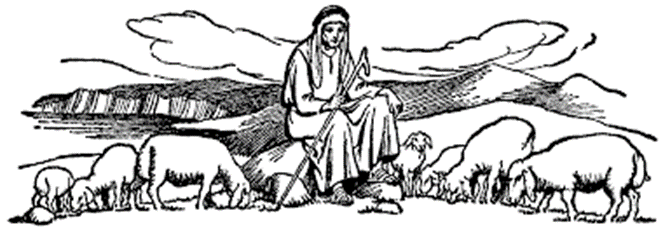
The shepherd cares for the needs of their sheep.
They only have what the shepherd supplies.
The Shepherd’s Responsibilities
Have you ever wondered why the analogy of shepherds and sheep are so important in Scripture? Let’s look at what a shepherd does and see how it applies to us today.
One of the principal duties at all seasons of the year is for the shepherd to plan food for his flock. In the springtime there is an abundance of green pasture, and usually the sheep are allowed to graze near to the village where the shepherd’s home is located. After the grain is reaped, and the poor have had an opportunity to glean what is left for them, then the shepherd brings in his flock, and the sheep feed on certain fresh growths, or dried blades, or an occasional ear of grain that the reapers may have left or was overlooked by the gleaners. When this source of food is exhausted then the pasture is sought in other places. Scripture often refers to shepherds looking for pasture for their flocks.
In the late autumn or winter months, there are times when the shepherd cannot find pasturage that is available for his flock, and then he must become responsible for feeding the animals himself. If the flock is small there may be times when the flock is stabled within the shepherd’s house, and the family lives on a sort of mezzanine floor above it. At such seasons of the year the shepherd must provide the food. In some places, flocks are taken at this season to places in the mountain country, where the shepherd busies himself with preparation of the bushy trees, cutting down branches that still have green leaves and tender twigs to eat.
In selecting pasturage for the flock, it is an absolute necessity that water be provided, and that it be easy to access. Often flocks are stationed near to a stream of running water. But the sheep are apt to be afraid of drinking water that moves quickly, or that is agitated. Therefore, the shepherd looks for pools of water, or provides some quiet place where they may drink and quench their thirst.
The Shepherd’s Tools
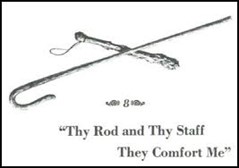
The shepherd’s rod is like a policeman’s club. It is often made of oak wood and has a knob on the weapon. It is very useful for protection. No shepherd would be without it.
The shepherd’s staff is a stick five or six feet long and sometimes has a crook at the end of it. It is used like a cane or walking stick. It is used in protecting the sheep from predators.
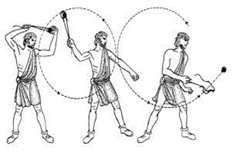
The shepherd’s sling was swung a time or two around the head and then was discharged by letting go one of the strings. The shepherd, in addition to using his sling against wild animals or robbers, found it very handy in directing the sheep. A stone could be dropped close to a sheep that was lagging and startle it into coming along with the rest of the flock. Or if one would get away in another direction, then a stone would be slung and dropped just beyond the straying sheep to bring it back.
Let’s take a familiar passage, the 23rd Psalm, and dig into what David was saying about the sheep and its shepherd.
The Lord is my shepherd, I shall not want
He makes me lie down in green pastures
He leads me beside still waters
He restores my soul
He guides me in paths of righteousness for His name’s sake
Even though I walk through the valley of shadow of death
I will fear no evil for You are with me
Your rod and Your staff they comfort me
You prepare a table before me in the presence of my enemies
You anoint my head with oil
My cup overflows
Surely goodness and love will follow me all the days of my life
And I will dwell in the house of the Lord forever
We will use the Inductive Bible Study method to review how it applies to us today.
Observation, Interpretation, Application
Observation
Probably your “observation” of this Psalm has been happening for years. Being such a familiar passage of scripture, we have heard it read, read it, and have heard some of the verses quoted over and over. Probably the most quoted verse is “walking through the valley of the shadow of death”; often a reference at funerals, although it is not referencing death specifically.
Interpretation
I wonder how many have stopped to “interpret” this Psalm? Who was saying what to whom? We know David wrote this Psalm to his Lord, but as you look at it, David changes from third party (He makes me, He leads me, He restores me) to second party (Your rod, You prepare, You anoint) to first party (I will fear no evil, I will dwell) as the Psalm moves on. It is like he was writing down his thoughts about his Lord to share with others, then turned to speak to Him directly and then turned it into a prayer of gratitude.
David, having been a shepherd, recognized the similarity between his sheep following him as a shepherd and David following the Lord, his Shepherd. He uses language a shepherd would be very familiar with. Jesus called Himself the Good Shepherd and said, “My sheep will hear My voice and follow Me. They will not follow another shepherd”. Sheep will only follow their shepherd’s voice. One of the great examples God has shown me of His Sovereignty is the fact He created sheep “in the beginning” knowing they would be the perfect example for David to write about in this Psalm and for us to recognize our dependence on the Good Shepherd today. He is amazing. Praise His Name!
David says, “The Lord is my Shepherd”. The Lord (not a lord, The Lord of lords) is my Shepherd and He sees to all the needs of His sheep. Sheep are totally reliant on a shepherd to care for their every need as we saw above. David then relates what the shepherd does for their sheep to what his Shepherd, his Lord, does for him. He cares for David’s physical, emotional and spiritual nourishment. He guides David’s path. David said even in the tough times he has no fear because his Shepherd is with him. David recognizes the rod and staff as comfort to help him not to go astray. Then David ends the Psalm by praising his Lord; his cup overflows and he will be with his Lord forever.
Application
The next step is application. Can we say the same thing about our Shepherd’s care for us? Take a moment and consider each of these questions. What would we change?
Are we totally reliant on His provision or do we worry and fret about our needs?
Are we able to accept whatever situations He allows into our life because we believe our Shepherd will always use it for good?
Do we feel correction is comforting, or wonder “why me”?
Can we say, “My cup overflows” even during trials? Surely goodness and love will follow me all the days of my life and I will dwell in the house of the Lord forever”?
Application is the key that unlocks the truth of Scripture if you believe it.
What did Jesus tell Peter?
After Peter denied Jesus three times before His crucifixion, Jesus reinstates Peter as the leader of His disciples in John 21:15-17 by using the shepherd/ sheep analogy.
15 When they had finished eating, Jesus said to Simon Peter, “Simon son of John, do you love Me more than these?”
“Yes, Lord,” he said, “you know that I love You.”
Jesus said, “Feed My lambs.”
16 Again Jesus said, “Simon son of John, do you love Me?”
He answered, “Yes, Lord, you know that I love You.”
Jesus said, “Take care of My sheep.”
17 The third time He said to him, “Simon son of John, do you love Me?”
Peter was hurt because Jesus asked him the third time, “Do you love Me?” He said, “Lord, You know all things; You know that I love You.”
Jesus said, “Feed My sheep”.
Shepherds in our life
Do we have shepherds in our lives today? Many people think of a pastor as a shepherd. That was Jesus’ message to Peter, feed and care for My sheep and lambs. From a spiritual perspective, that is what pastors do today. What is the definition of shepherd other than caring for sheep in the fields?
Webster’s Dictionary says the definition of a shepherd is “A person who protects, guides, or watches over a person or group of people.” Does this definition apply to people in our lives?
Parents-
The definition clearly fits parents. The parent’s role is to “protect, guide, and watch over” their child from birth through life until adulthood.
Teachers-
These same responsibilities hold true for teachers. Although their role is a much shorter time frame, they do “protect, guide, and watch over” their students.
Workplace-
Do we recognize this responsibility carries over into the workplace? The culture of the workplace is created by the decisions and policies established at the executive level and cared out at the manager’s level.
Do we recognize when we are in any role that has authority over another person, that role also has responsibility to “protect, guide, and watch over” that person? When a person is under the authority of another, they have very little control in the situation. As their shepherd we can make their time with us comfortable or uncomfortable depending how well they feel “protected, guided, and watched over”.
I worked for a man that understood this responsibility. I was the Employee Development Director. We had approximately 150 employees. If we had a problem employee, he would say to me, “I am responsible for 150 families which probably equals more than 500 lives. I will not let one problem employee have a negative effect on 150 families. Help them improve or help them move on.” As the shepherd he was willing to protect his sheep from harm.
Think about the areas of our lives where we are either the “sheep” under authority of a “shepherd” or we are the “shepherd” responsible to “protect, guide and watch over” others. Do we understand our role? How different would families be? How different would the classroom be? How different would the workplace be?
I have been in management in a manufacturing setting for 40+ years. I have recognized companies that care for and build into their people have less turnover and make higher profits than companies that see their people as necessary bodies to complete their work. The Biblical truth in the 23rd Psalm applies everywhere in life. All we need to do is believe it and apply it.

 Christian Life Coach