
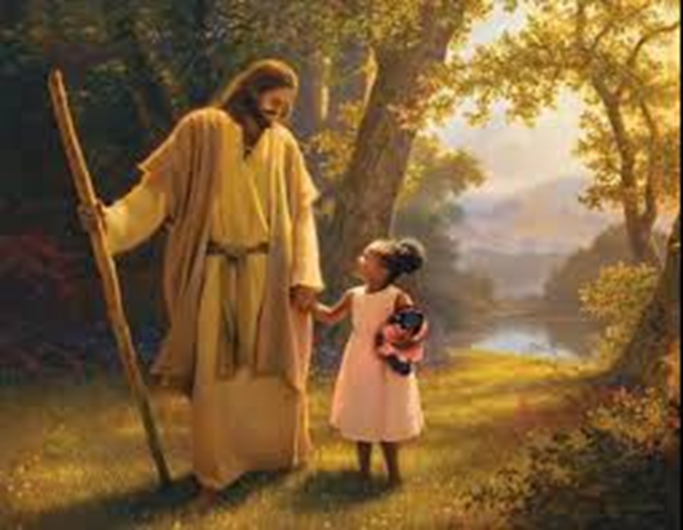
“Unless you have the faith of a child, you will never see the Kingdom of God”
Preface
What do you see when you look at this picture? To me, it is a picture of the child-like faith Jesus calls us to have. Let me tell you the story I see. The child represents you, me and all of God’s people that recognize the Good Shepherd’s voice.
This child of God has been walking a path (in the background) that was confusing and not clear. They were holding onto things of this world (pictured as a stuffed animal) for security. They heard the Good Shepherd’s voice “around the corner”, passed through an opening (under the tree limb), looked up and there He was with His staff in hand “to comfort me” as David said in Psalm 23. God’s child put their hand in His and immediately a sense of peace and calm came over them and He guided them out of the confusion.

Hello, I am Tom Stanfield. I have gathered together into this devotional many thoughts I have written about over the last decade throughout my journey with our Heavenly Father. My greatest desire is for you to draw closer and closer to our Father and to know what you believe and why you believe it, not what I or others say or believe, but know for yourself what you believe and why you believe it.
Michael Card, my favorite author and song writer, wrote a line in a song that helps me ponder the wonders of God and His desire for His people. The line is, “Sometimes the questions bring us better answers than the answers ever will”. Like in Genesis 5:24, “Enoch walked faithfully with God; then he was no more, because God took him away.” That statement challenges me. How does a man walk that faithfully with God?
The problem I see with man trying to answer “the questions” is all we get is man’s knowledge and understanding. Because every person interprets the answers to life’s questions through their paradigm, or filter, that their journey of life has taken them through, and when two people with different paradigms try to answer the same question, they come to a different conclusion. Only if the paradigms are aligned, will the conclusion be the same.
However, unless the paradigm alignment comes from our Heavenly Father, we still end up with man’s understanding. The problem I see in the Body of Christ today is all the theological and denominational differences have splintered the Body of Christ into so many pieces that the Body is anemic when it comes to delivering the message about the relationship our Heavenly Father desires to have with us.
We are told in Scripture that quarrelling and factions are sinful, and yet is that not the state of the Body of Christ today? It makes me think of Paul’s plea to the Corinthians to not split into followers of Apollos, followers of Peter or followers of Paul. He told them they need to be followers of Christ.
Why do we debate issues like you can lose your salvation or not, when the real question is are people walking with Christ or not? Does it matter whose theory is correct or isn’t salvation about each individual’s response to the Lordship of Christ?
Why do we argue over pre-trib, mid-trib and post-trib? The timing is in God’s hands. The rapture will happen in God’s time. Again, is it worth arguing over timing or should we be focus on sharing God’s message with a lost world?
Do we appear any different to the unchurched than the politicians of today appear? Republicans and Democrats disagree. Calvinist and Armenians disagree. Are we, like in Corinth, separate groups of people believing only our way is right? Aren’t we called to be one Body of Christ? How can a seeker know where to turn to find the relationship with their Heavenly Father that they so desperately need if all they see is a fragmented Body and the confusion of different denominations throughout their community?
The list of questions goes on and on. I believe Satan’s biggest tool today is man’s pride; his need to be right. For any man to think they have all the answers is foolish at best and very scary to me. To me, the scariest verses in the Bible are Matthew 25:31-43, where Jesus separates the “sheep and goats”. These are all people that call Jesus “Lord”, and yet many are cast into hell. I believe it is a picture of the church today.

The message that Jesus presented was very simple, not twisted up in religion and rules. In fact, Jesus challenged many of the “rules” of His day. When asked the greatest commandments Jesus replied, “The first is love God with all your heart, all your soul and all your mind. The second is to love your neighbor as yourself”. Then He added, “All the Laws and the Prophets are in these two commandments”. The entire Old Testament message reduce to two easy to understand commandments, both based on love; other focused, not self-focused.
Jesus also said, “By their fruit you will know them”. Can others see our “fruit” when it comes to loving God and loving others? If we can see the fruit in individuals, the argument over the timing of salvation is meaningless. We can debate all day if someone “fell away” or were “never really saved”, but the question isn’t theology, it is their personal relationship with God and the Fruit of the Spirit it bears. It is that simple. We need a closer walk with our Father, not choosing sides in a theological debate.
I guess that is why I love the book of Ecclesiastes. Solomon, the wisest man that ever lived, said in his book everything “under the sun” is meaningless; ultimately meaningless. Only our relationship with our Heavenly Father and our witness to the world have any lasting value.
One of my favorite author/ speakers is the late Ravi Zacharias. His passion was stated in his simple statement, “Let My people think”. I echo his thought. Think and know why you believe what you believe.
So many people hear a pastor or speaker make a statement about Biblical truth and accept it because the man in authority said so. We need to “take every thought captive”, read Scripture ourselves, meditate on it, seek the Father’s wisdom to really know the truth. Know exactly what you believe and why you believe it. Know your source of knowledge is true. The rest is between you and God. May He guide your journey.
Table of Content
Walking with God – Being Led by the Spirit
- Do We Let Scripture Speak?
- Decisions or Disciples?
- Are You Willing?
- Hard Teaching
- Under the Son, or Under the sun?
- Test the Spirits
- Parable of the Bush
- Surrender
- Man Born Blind
- In Jesus Name, Amen
Loving God – Contemplating Our Amazing Heavenly Father
- In the Beginning God Created
- The Trinity
- The Peace of God
- Faith Like a Child
- The Power of the Paradox
- Do Whatever He Tells You
- Where Else Would We Go?
- Ecclesiastes
Loving Your Neighbor – Love is an Action, not an Emotion
- “I”-dolatry
- For Better or For Worse
- When a Gift is Truly a Gift?
- My Turtle and Me
- And the Two Will Become One
- Love One Another…A Work in Progress
Product of a Closer Walk – By Their Fruit You Will Know Them
- Stewardship
- 24 Gold Coins…A Life Well Spent
- A Need or a Want?
- Who are You Between the Pages of His-story?
- Soil that Produces Good Fruit
- What Controls Our Focus?
- Entitlement
- Sacrificial Giving
Walking with God- Being Led by the Spirit
Do we let Scripture speak?
I heard a well delivered message on listening to God speak through His Word. The passage used was James 1:19-25. Verse 19 says, “Everyone should be quick to listen, slow to speak and slow to become angry”. The passage goes on to say, “Humbly accept the Word planted in you”. Verse 22 says, “Do not merely listen to the Word, and so deceive yourself. Do what it says”.
The Pastor then took “Humbly accept the Word planted in you” and ran it through the “soils” in the Parable of the Sower in Matthew 13. He mentioned he was a big fantasy football fan. He said, “If I am setting in church and am thinking about which players I should play on my fantasy football team this Sunday while God’s Word is being shared, I am letting the “cares of the world” block me from hearing what God wanted me to hear. I have let Satan “snatch” the Word that was “sown”. How often we are distracted when God is trying to get our attention.
That made me think about how easy it is to be “doing good things”, like going to church or reading the Bible, and yet we are simply going through the motions. Michael Card, wrote about our weekly tradition of going to church and said, “We weekly go and coldly mouth the words”; a scary thought. We are not really listening to what God has to say to us. In fact, aren’t we often filled with pride because we “already know the right answer” and we look around in judgment at others? How do we hear what God is saying to us if we don’t listen?
For years I struggled to find a Bible Study method that would help me understand what God was saying through the passages I was reading. The best Bible Study method I have ever found is the Inductive Bible Study method. It teaches three steps; Observation, Interpretation and Application. This simple process has revolutionized the way I attempt to understand Scripture.
Observation is typically accomplished from reading, but there are also video presentations that use scripture word-for-word. However, we choose to accomplish Observation, it is critical to “hear” what scripture says, not pass it through the “filter” of what we currently believe. Keep an open mind to allow God to challenge our thoughts and guide us into a deeper understanding. I once heard a famous pastor say on a radio program, “Don’t let scripture confuse you. We already know what we believe”. That is a scary statement. It assumes we have nothing left to learn.
Interpretation happens when we seek to understand who was saying what to whom and in what situation. Do we know who the writer was? Do we know who their audience was? Some books are easy, like Paul writing to the Church in Corinth. Others like Hebrews are less clear. Also, we must interpret the “word pictures”, references of their time in history (like shepherds and sheep) or parables (stories with a hidden double meaning), to allow us to interpret what the writer was saying. However, the one thing we can be certain of is scripture is for believers. If you or I are hearing it or reading it, that passage is specifically for us. We need to listen to what God is saying to us; not look around and judge others.
Application is probably the biggest missing element to most Bible Study. I feel many people read scripture and get the message in theory, “God loves the world so much He sent His Son”, but don’t know how to apply the theory to their everyday lives. This causes people to ask questions like, “How can a loving God send good people (our perception of good) to Hell?” instead of accepting His definition. The application comes when you understand the rest of the thought, “Whoever believes in Him will be saved”. If someone thinks “believes in Him” means you believe He existed, like Abraham Lincoln existed, your application will be completely different from those that know “believe in Him” leads to a changed life and a surrender heart; a bond servant.
Let’s take a very familiar passage, the 23rd Psalms, and think through it inductively.

The Lord is my shepherd, I shall not want
He makes me lie down in green pastures
He leads me beside still waters
He restores my soul
He guides me in paths of righteousness for His name sake
Even though I walk through the valley of shadow of death
I will fear no evil for You are with me
Your rod and Your staff they comfort me
You prepare a table before me in the presence of my enemies
You anoint my head with oil
My cup overflows
Surely goodness and love will follow me all the days of my life
And I will dwell in the house of the Lord forever
Probably your “observation” of this Psalm has been happening for years. Being such a familiar passage of scripture, we have read it, heard it read and have heard some of the verses quoted over and over. Probably the most quoted verse is “walking through the valley of the shadow of death”; often a reference at funerals, although it actually is not referencing death specifically.
I wonder how many have stopped to “interpret” the Psalm; who was saying what to whom. We know David wrote this Psalm to his Lord, but as you look at it, David changes from third party (He makes me, He leads me, He restores me) to second party (Your rod, You prepare, You anoint) to first party (I will fear no evil, I will dwell) as the Psalm moves on. It is like he was writing down his thoughts about his Lord to share with others, then turned to speak to Him directly and then turned it into a prayer of gratitude.
David, having been a shepherd, recognized the similarity between his sheep following him as a shepherd and David following the Lord; his Shepherd. He uses language a shepherd would be very familiar with. Jesus called Himself the Good Shepherd and said, “My sheep will hear my voice and follow me. They will not follow another shepherd”. Sheep only follow their shepherd’s voice. One of the great examples God has shown me of His Sovereignty is the fact He created sheep “in the beginning” knowing they would be the perfect example for David to write about in this Psalm and for us to recognize our dependence on the Good Shepherd today. He is amazing. Praise His Name!
We are His sheep-
1. The Lord is my shepherd, I shall not want (sheep have what the shepherd supplies, he cares for their wants)
2. He makes me lie down in green pastures (sheep need to be made to lie down to rest)
3. He leads me beside still waters (sheep are afraid to drink from moving water)
4. Your rod and Your staff they comfort me (a rod is used for correction, interestingly used here with comfort)
5. You anoint my head with oil (the shepherd pours oil on cuts and scrapes to sooth and heal each sheep)
6. Walk through the valley of the shadow of death (sheep are afraid of shadows in the deep valleys)
David says “The Lord is my Shepherd”. The Lord (not a lord, the Lord of lords) is my Shepherd and He sees to all the needs of His sheep. Sheep are totally reliant on a shepherd to care for their every need. David then relates what the shepherd does for their sheep to what his Shepherd, his Lord, does for him. He cares for David’s physical, emotional and spiritual nourishment. He guides David’s path. David said even in the tough times he has no fear because his Shepherd is with him. David recognizes correction (rod and staff) as comfort to help him not to go astray. Then David ends the Psalm by praising his Lord; his cup over flows and he will be with his Lord forever.
The next step is application. Can we say the same thing about our Shepherd? Are we totally reliant on His provision? Are we content with what He has provided? Are we able to accept what He allows into our life because we believe our Shepherd will always use it for good? Do we feel correction is comforting? Can we say, “My cup overflows? Surely goodness and love (even in the trials) will follow me all the days of my life and I will dwell in the house of the Lord forever”? Application is the key that unlocks the truth of scripture, if you believe it and apply it.
So, I challenge us to let scripture speak. I sense many times we read scripture through our own filter. Our filter made up of what life has taught us or what a Preacher said that lead to what we believe to be true at this current time. I have found if I read a passage without trying to make it fit my current beliefs, it allows the Lord to challenge my preconceived ideas and expand my knowledge of the truth. Many times, I have learned what I thought was true was not, but I do not always get a clear understanding of what the passage does mean. However, I do know that all Scripture is true. If I come across what seems to be a conflict in my mind, I know I simply don’t yet understand. I do know Scripture passages do not conflict with other Scripture passages.
I quoted Michael Card before. As I mentioned, he wrote in a song, “Often the questions tell us more than the answers ever do”. I have found that to be true. If I find Scripture that I can’t quite get my mind around, what it shows me is how much greater the Lord’s understanding is than mine. I also know that if He needs me to understand it someday, He will make it clear to me.
Let me give you an example. Near the end of Jesus’ suffering on the cross He said to one of the thieves with Him in Luke 23:43, “I tell you the truth, today you will be with Me in paradise”. However, when the women saw Jesus after His resurrection a few days later, He said to them in John 20:17, “Do not hold Me for I have not yet returned to the Father”. On Friday He said today He would be with the thief in paradise. On Sunday He said He had not returned to the Father yet. How can they both be true?
Is this a contradiction of truth? No because we know that all scripture is true and useful for teaching, etc. The question it leaves me with is what did Jesus mean by today in Luke 23:43? My answer is… I don’t know, but I do know it wasn’t that Friday. This is an example of an opportunity to put down your preconceived ideas and open your mind to what scripture tells us. Scripture also says, “To the Lord a day is like a thousand years and a thousand years is like a day”. We see in time. He sees in eternity. Our filter tends to cloud some truths and puts God’s truth in a box of our own making.
Do we let scripture speak? Can we accept that God’s understanding is way beyond ours? Can we be open to believing there are truths that He has not yet revealed to us? Scripture says God’s truth is foolish to man and God’s ways are greater than our ways. We need to not put God into a box of our own design. After all, creating God and His truth in our image is idolatry. We need to let Scripture speak, learn from it and realize we don’t yet understand all of God’s ways.
A Closer Walk. Ask the Lord to guide your thoughts and look deeper.
I suggest you use the Inductive method to really understand what God is telling you in this blog and scripture references. You can use a form like the one below or something of your own creation. The goal is to let God speak to you where you are and to know why you believe what you believe. Doing this after each blog will help you go deeper in your understanding.
Observation
What did I just read? What did the Scriptures references say?______________________________________________________________________________________________________________________________________________________________________________________________________________________________________________________________________________________________________________________________
Interpretation
What Scripture or phrases do I need to research to understand the meaning?
______________________________________________________________________________________________________________________________________________________________________________________________________________________________________________________________________________________________________________________________
Application
What did it say to me? How can I apply the principles I learned to my life today? ______________________________________________________________________________________________________________________________________________________________________________________________________________________________________________________________________________________________________________________________
Decisions or Disciples
A couple of things I have recently come across have challenged me. They have driven me to ponder a few questions. Again, I refer to Michael Card’s line in a song that affects the way I think. The line says, “The questions often tell us more than answers ever will”. I am a ponderer. I ask questions and seek to better understand myself, others, my world and especially my God and His call on my life.
The first thing that challenged me was a book I read; “Not a Fan”. It challenges “believers” to ask themselves the question, “Are you a Fan of Jesus or a Follower of Jesus?” Because I love sports, I get the analogy. Fans come and go. When the team is doing well, they show up to enjoy the “good times”, but where are they in the hard times (like the Detroit Lions’ 2013 season) or when the team has multiple losing seasons? Followers on the other hand are committed to the team good times and bad. They support the efforts even when the results are less than desirable. They stay faithful in the valleys and on the mountain tops. I love the question: Are you a fan or a follower? It makes me reflect on my own faith. It is not asking me what I do with my faith. It is asking me who I follow; who leads my decision making.
The second was a message I heard on television. A Pastor, Chip Ingram, asked the question, “Why are there so many decisions but so few disciples?” He proceeded with his message which was very similar to the fan/ follower concept. People make decisions in the passion of the moment like following the new hot sports team but when things become challenging and less exciting, they fade away. They are not disciples, only fans.
I have led Bible studies. I say I led Bible studies, not taught Bible studies, because I believe what Jesus said, “There is only one Teacher and that is the Holy Spirit”. If we are teachable, the Holy Spirit takes us from where we are to where He wants us to be in small steps. The message in a particular Bible study may or may not touch a given person at that moment in time. It may not be an area that they have been given “ears to hear” yet. The great thing is that the message may be recalled later at the Spirit’s prompting. He is the Teacher; the Bible study leader is only the facilitator.
The question is as facilitators, what messages are we planting for future watering. What kind of message is the Church giving the world today? Some messages have been called “getting fire insurance”. Others seem to be offering a “life filled with prosperity”. Still others seem to teach that denying yourself everything will give you a great reward later. All these thoughts are based in Biblical truth. The problem is context and communicating the meaning of the message. Is Jesus looking for fans or followers?
I believe the problem starts with how some people see God. Is God here to please us or are we here to please Him? Are we here to focus on pleasing our self or to serve God? Look around the room you are in right now. Are you the center of what you can see? Of course you are. By nature, we see ourselves as the center of our world. That is why Biblical thoughts like the following seem backwards; you must give to receive, you must die in order to really live, turn the other cheek, pray for you enemy, etc. These statements make me think of another Michael Card line, “The power of paradox will open your eyes, and blind those who think they can see”.
The scripture list goes on and on. We tend to gloss over them because they don’t really resonant with our humanity. These messages are not me centered, but we are. Is scripture talking about pleasing people or pleasing God? Is it entertainment centered or disciple centered? Is it fan focused or follower focused?
So, in my pondering these questions I asked myself what was the message that Jesus gave His followers that revolutionized their world? What did He say to the fishermen that lead them to become disciples? Didn’t He simply say, “Follow Me” and they left their life as fishermen and followed Him? The same message was given to Matthew the Tax Collector and the others; “Follow Me”. Can it be that simple or were these men “given ears to hear” prior to their call?
I think of other people in the scriptures that heard the same message from Jesus and did not respond. Think about the rich young man who wanted to know how to receive eternal life (Matt 19:16-22, Mark 10:17-22, Luke 18:18:23). He told Jesus he had led a pure life by following all the commandments from the time he was young. After a conversation with this man, Jesus simply said to him following all the commandments isn’t enough. Give up your worldly goods and “Follow Me”. The man “went away sad”. His wealth had a greater hold on him than his desire to follow Jesus. Riches were between Jesus and him. They had more value to him than following Jesus. His problem wasn’t his riches. The problem was his riches were more important to him than doing what Jesus asked him to do. His riches were his god.
Others had different excuses (Matt 8:19-22, Luke 9:57-62) like “I need to go and bury my father” or “I just got married” or “I need to say good-bye to my family” or “I need to wrap up my business first”. Things of this world stood between them and following Jesus. Does that mean that other voices were more in tune with what they really desired; a comfortable life, family responsibilities, etc.? Another incredible word-smith, Rich Mullins, wrote in a song, “The things of this world compete for the allegiance I owe only to my King”. A challenging thought that I need to review often. Is anything between my King and me?
In Luke 9:62 Jesus said, “No one who puts his hand to plow and then looks back is fit for service in the Kingdom of God.” That message is straight forward. Do I ever look back? Do you? Notice He said “fit for service”. Are we seeking service or self-satisfaction? What is He calling us to? In Acts 5:40-41, after they had been whipped for sharing about Jesus, the Apostles “were happy because God considered them worthy to suffer disgrace for the sake of Jesus”. I don’t think I have ever heard that message from the pulpit.
In Matt 10:37-38 and Luke 14:25-26 Jesus said, “Those who love their father or mother more than me are not fit to be my disciples; those that love their son or their daughter more than me are not fit to be my disciples. Those who do not take up their cross and follow in my steps are not fit to be my disciples”. Jesus didn’t say the journey would be fun. He didn’t even tell them where they were going. He simply said “Follow Me”. Some did and some didn’t. The same thing happens today. Some do and some don’t. Why?
At this point in my search for answers it seems to me that the “Parable of the Sower” holds a key (Matt 13:1-9, 18-23, also in Mark and Luke). My paraphrase of this parable is that some people have not been given “ears to hear” so Satan snatches away the truth as soon as they hear it. Some people have been allowed to hear the message and believe it, but for various reasons they let the things of this world speak louder to them than Jesus’ voice. As in the beginning with Adam and Eve, Satan fills their heads with doubts and they fall away from the “truth that can set them free”. Other people are given “ears to hear” the message, take it in deeply and are fruitful. They don’t allow the whisperings of Satan to distract them from the truth of the gospel. They heed the call; “Follow Me”. They are followers, not just fans.
It’s the group in the middle that I believe are a distraction to the Church today. They are in church regularly. They say they have made a decision for Christ (whatever that phrase means to them). However, they are fans not followers. They made a decision hoping for a better life, but they are not willing to surrender. They come for the entertainment. They want people see them and believe they are good people. As long as the message feels good, they will be there, but call them to a deeper commitment like Jesus did to the rich young man and they will eventually show which soil they are planted in. They will find a message somewhere else that “tickles their ears” or they will band together with other fans and drive the messenger out of their church because the message makes them uncomfortable; fans not followers making decisions, but are not committed enough to want to be disciples.
What concerns me is how much of today’s ministry efforts are spent trying to turn fans into followers. Is that the job of the Church or is that God’s job? Didn’t Jesus tell Peter to “feed My sheep” (John 21: 15-17)? He didn’t say feed the goats and hope they turn into sheep. Only He can do that. Jesus said, “People cannot come to Me unless the Father draws them to Me” (John 6:44 and, 6:65). Shouldn’t we be “feeding the sheep”? Shouldn’t we be focused on the followers that “hear His voice and follow Him”? Isn’t that what Jesus did?
In John 10, Jesus calls Himself the Good Shepherd. Perhaps we have lost the meaning of this parable. Sheep follow their master’s voice. In Jesus’ time multiple herds of sheep were placed in a common sheep pen. When the shepherd was ready to move on, he would call to his sheep and only his sheep would follow him. Jesus is the Good Shepherd. Only His sheep will follow Him. In John 10:16 Jesus goes on to say, “There are other sheep which belong to Me that are not in this sheep pen. I must bring them, too; they will listen to My voice and they will become one flock with one Shepherd”. They will listen to His voice, not our voice.
I am not questioning peoples’ Christianity. I am not their judge. There is only one judge. My purpose in the illustration is to challenge who we focus on. If the message is focused on fans and tells them “God is here to please you”, we will never be like the first century Church. Their faith in and commitment to God was a magnet that God used to reach His sheep that were not yet in “His pen”. They focused on followers, not fans.
There is one small word that I think is the center of the whole problem. The word is “me”. I feel the message today is often focused on trying to persuade people that they will have a better life. That once they tap into the “power of God” their life will be great. Their life will be better. Their perceived needs will be met. Just tap into the power. However, the better life Jesus promised is the result of following Him, not a goal to obtain. It’s the result, not the target. The better life is not something we can plan for. It is beyond our imagination.
I have never read the me message in Jesus’ teachings. He said, “Pick up your cross and follow Me”. A cross is not about “pleasing me”. He never said follow me and things will be better. He said follow me and they will persecute you. He said “I came to serve, not be served”. I haven’t heard the “Follow Me” message preached very often. It seems to me today’s Church is full of spectators, or fans, not followers because that is who we are focused on. Don’t push them or they might leave. They make a decision after some passionate message in an emotional moment but have no desire to be disciples. They want a better life and fire insurance. They want to be entertained and feel good about themselves. They see themselves as the center of the universe, not a servant of the Living God. Are these the sheep we are called to feed?
Why don’t we call people to follow Him? Is it because it is not a seeker friendly message? Was Jesus’ message ever seeker friendly? The passage that is the core of my belief is in John 6:25-69. Jesus is giving a “hard teaching” saying to the crowd unless you “eat my flesh and drink my blood: you cannot be my followers” (John 6:53). The crowd couldn’t handle the message and they left. Jesus then asked the Disciples if they were also going to leave. Then in 6:68 Peter said, “Lord, to whom would we go? Only you have the words of eternal life”. I love that verse! It says it all to me; even if I don’t understand the situation “to whom else would I go”? Even if the path seems dark and painful to whom else would I go? To whom else would you go?
Fans go away in hard times. Followers know there is nowhere else to go. Even when they cannot understand the situation, they know Who does and they follow Him. It comes down to this; is God the center of your universe, or are you? For myself I have come to this conclusion…this life is not about me. It is about God’s plan. The one He is unfolding. The question is am I willing to be a pawn on His chess board or do I need to be the king on my chess board? Those that He chooses to call and allow them to hear His voice are His followers. He lets their roots go deep into His good soil. They are surrendered. They are fruitful. They are disciples.
Paul calls himself a “bond servant”, one who is bought with a price and owes his life to his Master. That is a follower not just a fan. That message will not draw big crowds, but it will change the lives of those that are given “ears to hear” it. I find great peace in being a bond servant. I don’t have to worry. I just have to follow. Our family has gone through many deep and varied trials, but we have seen God “use all things for good”. Notice it doesn’t say all things are good. It simply says He will use them for good if you let Him lead. Being a bond servant is actually easier that trying to foolishly control a world that is not under your control.
Is it our purpose to lead people to decisions or to discipleship? In Matt 28:19-20 Jesus said, “Go to all people everywhere and make them My disciples”. I think His message is clear. He is seeking followers not fans; disciples not decisions. I believe the Church needs a transfusion of disciples.
So, I asked myself what is a disciple? The very next day I was reading in John 15 and there was the answer. John 15:8 says, “This is to my Father’s glory, that you bear much fruit, showing yourself to be My disciples”. So how do we “bear fruit”? John 15 is the passage on the vine and the branches. 15:5 says, “I am the vine; you are the branches. If a man remains in Me and I in him, he will bear much fruit; apart from Me you can do nothing”.
A few days later Chip Ingram was talking about the Body of Christ (Romans 12); the familiar parable talking about the need for all parts of the body to function as designed by God. 12:6 says, “We all have different gifts, according to the grace given us” and goes on to describe them. So, if we are the Body of Christ, we should be using our gifts (our part of the body) to “bear much fruit” as the “vine” supplies our needs for the task.
Interestingly both passages end by talking about loving each other. John 15:12 says, “My command is this; love each other as I have loved you”. Romans 12:10 says, “Be devoted to one another in brotherly love. Honor one another above yourself”. Discipleship is not about me. It is about loving others and being fruitful in the Kingdom. In fact, scripture says we will recognize Jesus’ followers because they love one another.
Through all of this pondering I have come to this conclusion. Disciples are not hard to recognize. They are Kingdom focused, fruitful with gifts given to them and shine a light in this dark world by displaying His love that the world around them cannot deny. This is not something a human can decide to do. They can only become that way by being a surrendered branch connected to The Vine.
Are You Willing?
I find the Christian walk to be very interesting. As humans we try hard to accomplish our goals. This seems to hold true with our walk with God. We work hard at doing all the right things, saying all the right things and acting out what we understand our Christian walk to be.
The thing I have come to realize is God does not ask us to work hard at Christianity, He only asks us to be willing. So, I challenge you to ask yourself, “Are you willing?” It is a question I have come to ask myself often and, interestingly enough, I find it to be a great source of peace.
If I believe God’s plan is all that matters and He has called me to be His bond servant, then shouldn’t I be willing to do, say or go wherever He wishes to complete His plan? In theory I think we would all say yes, but when the rubber meets the road why do we waiver? We begin finding reasons why this can’t be what God wants me to do or like Moses, “but Lord I am slow of tongue” (as if God didn’t already know that). He just asked Moses to be willing, and then He supplied Aaron.
I remember hearing Chuck Swindoll talk about his calling to be a pastor. He said in his prayer to God, “I am willing to pastor anywhere…except California”. He wasn’t willing to go to California. Guess where God sent him…California. God had a different plan.
The truth is we just simply need to be willing. God will supply what we need to accomplish His will. James 4:12-14 talks about people make statements about what they will be doing in the next year. But then James 4:15 says, “What we should say is this: If the Lord is willing, we will live and do this or that.”
If we “drive the bus”, we get what we can accomplish. However, if the Lord drives the “bus” we get to live the promised “abundant life”. Which would you prefer? Silly question, and yet we find ourselves struggling to be willing.
Abraham received a shocking message from God. However, he figured God had a plan and he must follow directions. When he took Isaac to the mountain, he was very sad. When he was shown the ram in the bush, he had a faith building experience. When he came back from the mountain, he had an amazing God story to tell people; including us thousands of years later.
The Christian life isn’t about God pleasing you. It is about you pleasing God. Are you willing? The next time you come to a fork-in-the-road decision, will you be willing to take the path God opens or will you beg God (calling it pray) to have your own way. Be honest with yourself. God can see the consequences, you can’t. If He closes a door will you try to pry it open with your own strength and abilities? If you do, you will not find the “abundant life” that was through the other door. Are you willing to take the path you don’t want if God opens that door? Are you willing?
Hard Teaching
What do you do with scripture that you don’t understand or even worse scripture you struggle to believe is true? Does it shake your foundation of faith? Does it make you wonder if some scripture is not correct or has not been translated properly?
I think about Job and all he went through. The reason appears to be that God wanted to show Satan what real faith is. That’s hard teaching. Even harder to me is all ten of his children were killed in this story. It is true that Job had other children later to replace them, but those ten people were dead. That is hard teaching to me.

How about Moses. He leads thousands of whining, complaining people for 40 years in the dessert. When he went to the mountain to get the Ten Commandments even his brother Aaron build a golden calf for the people to worship. He lived under constant strain. When they were at the end of the journey Moses struck a rock against God’s direction. After 40 years of service that one act kept him out of the promise land and Joshua became their leader. That is hard teaching to me.
However, the Bible says that all scripture is true and to be used for teaching. I have learned that when I come across scripture that is hard for me to understand God has simply not given me the ability to understand at this time. After all He is God. His truth is His truth. He said His ways are not our ways. So, I have come to this; if I don’t understand it or actually disagree with it, the fact is it is God’s truth and when He feels I need to understand it He will enlighten me.
My life verse is John 6:68. In this chapter Jesus was giving a hard teaching. He told the crowd in John 6:48-51, “I am the bread of life…The bread that I will give you is my flesh, which I give so that the world may live”. The crowd responded, “How can this man give us his flesh to eat?” They did not understand what He meant. We look at scripture 2000 years after the events. We hear them over and over. We wonder why they don’t understand. They don’t understand because they haven’t been given “the eyes to see” at that point.
As this passage goes on many of His followers left because they could not understand. John 6:67 says, “So He asked the twelve disciples, ‘And you, would you also leave?” Then 6:68 (my life verse), “Simon Peter answered Him, ‘Lord, to whom would we go? You have the words that give eternal life. And now we believe and know that you are the Holy One who comes from God.”
To me that verse says it all; Lord, to whom would I go? He has given me the faith to “believe and know”. That is amazing to me; a faith that cannot be shaken by not understanding some detail. The “faith of a child” Jesus talked about. I am humbled and grateful.
Under the Son or Under the Sun
One of my favorite books in the Bible is Ecclesiastes. I have heard people question why this writing was included in scripture. It is so negative they complain. I see it totally different. To me it is one of the most freeing books in the Bible. If we believe that the Bible is the inspired Word of God and all scripture is good for teaching, then we need to find the teaching points in Ecclesiastes.
Think about who God had write this book. God Himself gave Solomon great wisdom. Rulers from other countries came to hear his council. At the time of his writing of this book he had lived 80 years being tempted by everything the world had to offer. If you think about it, he was tempted with the same three temptations Jesus was tempted with; lust of flesh, pride and power; the same temptations we all face. However, looking back over his 80 years, with the wisdom God gave him, he shares what the Lord has taught him.
Ecclesiastes 1:2 says, “Meaningless, meaningless says the Teacher. Utterly meaningless! Everything is meaningless.” Ecclesiastes 1:14 says, “I have seen all things that are done under the sun; all of them are meaningless, a chasing after the wind”.
I believe if you really think about those verses you will agree. Everything under the sun is temporal. It will be gone in time and ultimately meaningless. However, if you think about humanity and its eternal destiny, heaven or hell, you can write the reverse of the statement; everyone under the Son are the only things that are meaningful. They are the only things in this world that are eternal. Therefore, I believe the writer is really saying; meaningful, meaningful, only being under the Son is meaningful. If you read Ecclesiastes in that light, I think you will agree it is very freeing.
The Teacher lists things that in the light of eternity are meaningless.
1:14 all things done under the sun are meaningless
1:17 applied myself to the understanding of wisdom, but it is a chasing after the wind
2:1 tested pleasure to find what was good, but that also proved meaningless
2:4-11 undertook great projects, denied myself nothing; nothing was gained under the sun
2:12-16 compared wise man and the fool, this too is meaningless, both will not be remembered long
2:17 the work that is done under the sun is meaningless, a chasing after the wind
4:4 all the labor and all achievement spring from one man’s envy of another, this too is meaningless
5:7 much dreaming and many words are meaningless
5:10 whoever loves money never has enough, this too is meaningless
7:8 like the crackling of thorns under the pot is the laughter of fools, this too is meaningless
However, he continues to bring the reader back to his or her relationship with God.
2:24-25 a man can do nothing better than find satisfaction in what he has, because it is from the hand of God
2:26 to the man who please Him, God gives wisdom, knowledge and happiness
3:11 God has made everything beautiful in its time
3:11 God has set eternity in the hearts of men
3:12 there is nothing better for men than to be happy and do good while they live
3:13 that everyone may eat, drink and find satisfaction in his toil is a gift from God
3:14 everything God does will endure forever, nothing can be added, nothing can be taken away
5:7 stand in awe of God
5:18 man should find satisfaction with his lot because God has given it to him
7:13 consider what God has done
8:15 enjoy his work and all the days of life God has given under the sun
In Chapter 12 Solomon wraps up his thoughts. In 12:1 he says, “Remember your Creator in the days of your youth”. In 12:13 he says, “Here is the conclusion of the matter: fear God and keep His commandments, for this is the whole duty of man”. I love that verse.
I believe we can learn a lot from this wise old man. Putting the things of this world in perspective has allowed me to better handle the curveballs the world throws my way. Eventually all the curveballs become meaningless; “a chasing after the wind”. Remembering everything “under the sun” will not last, but the people under the Son have eternal value, helps me focus my priorities. Do I really need to catch the next gold ring or is sharing what God has shown me truly more valuable?
The three great temptations that entice us all, lust of flesh, pride and power, do not seem so appealing when you recognize they are ultimately meaningless. It makes me think of a quote that was on a local company’s take-out bucket. It read, “What is done for this world will so be past, but what is done for Christ will forever last”. I can’t say it any better than that.
When you get a chance, read Ecclesiastes again thinking about the difference of “under the sun” and “under the Son”. Solomon’s writing actually makes me smile, especially when I read “meaningless, meaningless; a chasing after the wind”. It really puts today’s worries in perspective. There are very few problems that have any major effect on us. Even when the valleys in life appear, we have our God at our side and the promise of eternal life under the Son. Scripture says, “If God is for us who can be against us?” Isn’t that all that really matters?
1 John 4:1 says, “Dear friends, do not believe every spirit, but test the spirits to see whether they are from God, because many false prophets have gone out into the world.”
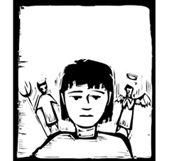
The concept of testing the spirits has added a great tool in my faith walk. I have come to recognize there are two voices talking to you at all times. This has been pictured many times in cartoons with the little angel on one shoulder and the little devil on the other. We laugh at them in the cartoons, but the idea that put them in the cartoon shows that the thought of their existence comes from somewhere. Everyone can remember a time in their own life when the voices of the little angel and the little devil had an almost audible battle in their head.
So how do we “test the spirits”? What do we use to measure the test? As we face any decision we can go with our gut and let feelings rule or we can put the thought through the filter of scripture and measure it that way. I believe the filter of scripture is the best measuring tool.
Take a situation where you knew you should have said or done something but you did not do it. The voices in your head start talking. Is the voice a gentle message of coaching to do better in the future or a harsh voice of condemnation? Is the message bathed in love and meant for your good or meant to beat you down and making you feel worthless?
When you step back and discern the tone of the message, understanding who the messenger is becomes clear. Then it becomes a choice of who you want to believe, or as I say, you can choose which team you want to play on. If you hear the condemning voice, recognize who it is coming from and then choose to have a pity party, you are clearly making the choice.
However, the key is knowing scripture well enough to use it as a measuring stick. This is a great reason to be in your Bible daily. I am a slow reader. I started years ago reading through the books of the Bible one chapter a day. Do the math. After 30 years I had read 10950 chapters. That has built a strong base to help me discern the voices. It is the consistent feeding from the Word that gives you the insight to discern the voices.
The next time you feel uneasy about a situation stop and “test the spirits”. Discern who is talking to you. Decide which team you want to play on. I find it really works.
Parable of the Bush
I love the way our God can speak to us through everyday occurrences, like one day when I was working on spring clean-up in our yard and began trimming the bushes behind our house. While hand trimming these bushes, thoughts about scriptural principles kept going through my head.
At first glance the bushes appeared to be green and growing. After pondering that initial thought, it made me think how people at church, at work, or in a store usually look fine as we casually glance at them. Some of them are trying hard to hide the cares and the pain they carry inside. We ask them, “How are you today?” and they typically answer, “Just fine”, but they could be truly hurting inside and don’t want to share that. First impressions and surface appearances are deceiving. I thought to myself how nice it is to have people who love you enough that you can share your concerns with them. It is awesome to have our God, who loves us unconditionally, to share our concerns with. After all, He already knows our concerns and cares deeply for us.
Next, I noticed that the growing branches were producing flowers. These flowers connect the branch with the rest of creation. The sun helps to nourish the branch, the bees gather from the flowers and help pollinate the plants and we are all drawn to the beauty. I also recognized the dead and dying branches were not producing flowers. Branches in the light produce flowers while branches underneath in the darkness do not. It made me think of Jesus’ statement in the Sermon on the Mount: “You will recognize them by their fruit”. People that live in His light (or truth) naturally produce fruit. However, people that hide from His light cannot produce fruit.
As I looked deeper at the bushes, I noticed that some of the new growth that was looking good and producing flowers was actually headed for trouble. Some branches were reaching out and touching the side of the house. This causes maintenance concerns, so they needed to be pruned and cut back. These branches made me think of the Parable of the Sower. The second and third soils contained seeds that began growing, but things of this world got in the way and stopped the growth. It made me realize that we need to carefully consider and understand the effect of the path we are on.
Then there were the dead branches that were covered by the green look of the outside appearance. It made me think of the sin we conceal under our Christian appearance; the deep struggle that Satan tempts us with again and again. I have come to call these our Achilles Heel. I believe God allows Satan to use these temptations to keep us relying on Him, like Paul’s “thorn in the flesh”. God told Him, “My strength is sufficient for you”. His strength is also sufficient for us.
A wonder to me was the fact that there were dead branches that were still connected to the bush. They were once a living, fruitful part of the bush. They had become useless, not even producing leaves and they were easily broken off the bush. They took away from the beauty and health of the bush. Like the scripture that talks about the dead branches being cut off and thrown into the fire, I broke them off and threw them into our yard waste dumpster. Jesus’ conversation about the vine and the branches came to mind. It amazes me that something or someone can become lifeless while connected to the source of life. Without debating if someone can lose their salvation or not, the thought of becoming lifeless in the Kingdom is both scary and motivating. Please God, keep me aware of the life-killing things the world sets in front of me.
I also noticed some branches were starting to die but trying to produce flowers. Their light was being blocked by the dead branches. They needed the bush to be pruned to allow the life-giving light to penetrate to them. Unlike the dead branches, they were not easily broken off from the bush. They wanted to be connected, but struggled in the darkness. It made me think of people on the fringes of Christianity. They want to be connected, but the darkness of this world blocks them. As Jesus said in John 6, only the ones the Father draws can come to Him. Only those that the Father allows can see the light. I pray the Almighty Gardener prunes the dead branches around them so they can see the light and partake of its life-giving truth.
Only our God can take something as simple as trimming bushes for 30 minutes to speak spiritual lessons to us. Praise His name for loving us so much. May He continue to prune us all so we are useful in His Kingdom.
Surrender
If you have been in church very long, you probably have heard messages talking about being surrendered. Typically, we think to ourselves of course we are surrendered. After all, that is what a Christian is, right? However, lately the word has been echoing in my heart and mind. What does it really mean?
Part of what has this on my mind is a book I have been reading by Michael Card titled, “Mark, the Gospel of Passion”. He quotes scripture word for word, then he comments on the verses and the depth he brings out is wonderful. If you are looking for a good book to read, I recommend it. In fact, he has a series on all four Gospels and I am working my way through them all.
In Mark Chapter 10 we find the story of a rich young man who asked Jesus, “Good Teacher, what must I do to inherit eternal life?” (Mark 10:17). Right away Jesus asked, “Why do you call Me good. No one is good but God”; challenging the works philosophy of what I must do. Then Jesus listed the commandments and the young man said, “I have kept all these from my youth” (Mark 10:20).
Jesus knew this was a man that followed the rules, but was he surrendered? Jesus’ reply was the defining point. “You lack one thing; Go sell all you have and give to the poor, and you will have treasure in heaven. Then come, follow me” (Mark 10:21). The young man “went away grieving”. He believed he had kept all the commandments, but he had actually broken the first commandment. He had put his riches before God.
I love what Michael Card wrote. He states, “Two worlds meet in these two men. One sincerely seeks to inherit eternal life as a reward for his actions. The other has come to offer eternal life as a free and gracious gift”. I don’t think the works versus grace issue can be explained any better than that.
This points out the blind spots we can have as humans. We believe we are surrendered to God and fully following Him. But as witnessed in the young man in the story, our definition might be skewed. As with the young man, the tough question is asking what is between you and God. What do you need to control and not want to let go of? Is there anything that you would struggle releasing; struggle to say, “Not my will, but Your will Lord”? That thought makes me think of the song “It is Well with My Soul” by Horatio Spafford. We have probably all sung this in church, but when you realize he wrote it after all four of his daughters drowned in a boating accident, it takes on a much deeper meaning.
This brings out a few thoughts. One is a loved one we are praying for to come to Him. Surely it is His will, right? What if it isn’t? In John, Scripture says no one can come to Jesus unless the Father draws him. What if He never calls our loved one or if they never respond to His call? Will it come between us and God? Do we want His will to conform to our will? Once I realized this a few years ago and surrendered control (that I never really had anyway), I actually found it easier to share my faith with the loved ones I am concerned about. It is God’s call, not mine. God challenged me with this thought and through tears I decided even if He doesn’t call someone I love, or they do not respond to His call, it will not stand between Him and me. You may not agree with this analogy, but if it is true where do you stand? Could it come between you and God? Think of the story of Job. In one fell swoop all ten of his children were killed. His wife said to him, “Curse God and die,” but he said, “The Lord gave, and now He has taken away. May His name be praised (Job 1:21)”. How would we react?
The other thought is our selfish nature. By nature, we want control. We convince ourselves that God certainly wants us to be happy and will give us the things we feel we need. However, His goal for us is surrender, not momentary happiness. He can see the future; we can’t. I have had experiences that seemed horrific at the time; polio when I was five, a simple out-patient surgery that nearly killed me and took two more surgeries to correct, Linda’s terrible fall and broken shoulder that produced a year of pain and suffering, etc. However, looking back at all these experiences, I can see the value of having experienced them. We can see in hindsight, but He has forward vision. As a parent with a child, sometimes we know a season of suffering will bring a positive outcome.
I find concepts like this easier to relate to when I put them into human experience. When our oldest son was young, he was bitten by a dog on the leg. The puncture wounds were deep. I had to take him back to the ER multiple times for them to remove the old drainers and then push new ones into his puncture wound. It was painful. He would look at me like, “Why are you letting these people hurt me?” However, from my perspective, I knew he had to go through this trial to be healthy. Do you see the analogy with us and God? To us it is painful. To Him it is necessary for our growth.
In Galatians 5 Paul draws the distinction between living in our will and surrendering to the Holy Spirit. We simply cannot live as God desires without surrendering to the leading of the Spirit. Sometimes our way seems better from our vantage point in time, but God’s vantage point is eternity. He uses the lessons we have learned from trials to give us wisdom to share with others. To me it boils down to this; my life is about God’s plan, not about me.
Darlene Zschech, one of the most amazing worship leaders I have ever listened to, sang these words, “I need You my God…that I might live by Your Word…wholly devoted to You”. Wholly devoted, not mostly devoted. We cannot be wholly devoted without His help. I agree with her words, “I need You my God…that I might live by Your Word…wholly devoted to You”. That’s what surrender means to me.
Man Born Blind
Jesus said, “This happened so that the work of God might be displayed in his life”. John 9:3
Jesus’ healing of a man born blind in John 9 is an interesting character study. We know why Jesus did miracles like this, to prove He was God’s Son and glorify the Father, but have you thought about the life of this man before and after his encounter with Jesus.
I like to ponder stories like this because it helps me contemplate God’s overall plan in a deeper manner. Put yourself in this man’s shoes. You were born blind. You have never been able to see anything; total darkness. You have to beg from others to even feed yourself. At the time of the healing, you are an adult. (We know this because in verse 21 his parents said, “Ask him. He is of age; he will speak for himself”.) Suddenly your life changes; you can see!
The progression of the story is full of interesting questions and opportunities for us to ponder.
John 9:1-2 –
As He (Jesus) went along, He saw a man blind from birth. His disciples asked Him, “Rabbi, who sinned, this man or his parents, that he was born blind?”
The disciples believed for something this tragic to happen it must have been caused by sin. The Jewish community all assumed that. That means the blind man’s whole life to this point was one of rejection. People would see him as a sinner inflicted by God; someone to be shunned. I imagine he had a very lonely life for many years. Remember Jesus said he led this life “so that the work of God might be displayed in his life”. He led a life of darkness and poverty so that, after many years of living like that, God would be glorified. Ponder on that thought for a minute. I believe some people would say a loving God would not do that. Scripture says otherwise. It is a foundation shaker. It does not allow God to be kept in the box of our own understanding. His ways are greater than our ways.
Then Jesus does a very strange thing, at least in my mind. Especially strange to people in our culture today that are so conscious of germs and disease.
John 9:6-7
“Having said this, He spit on the ground, made some mud with the saliva, and put it on the man’s eyes. Go, He told him, wash in the Pool of Siloam. So, the man went and washed, and came home seeing.”
Let’s get back in the blind man’s shoes. There is no recorded conversation between Jesus and the man, but I assume Jesus had said something to the man before He put the mud on his eyes. When questioned later the man said it was Jesus that healed him. He probably knew of Jesus reputation as a healer. However, here he is blind and not even able to see what is going on. Then this gentle man that he does not even know spits on the ground, makes mud and puts it on his eyes.
This is one of the moments in scripture that helps me see God’s preparation of an individual prior to him being thrust into the forefront of God’s plan. How many people would allow a stranger to put mud on their eyes made from saliva? I am not sure that would ever happen without the Holy Spirit’s guidance in the situation.
The end of verse 7 amazes me. “So, the man went and washed, and came home seeing”. Remember he is blind, but he still had the faith to follow Jesus’ directions. He had to find his way to the pool. He may or may not have had help. However, he certainly was filled with the hope only faith can give you. He did as instructed and “came home seeing”. Amazing miraculous healing!
After the healing, people that knew him were confused. Some said it was him; others said he just looked like him. They noticed the change and asked him, “Who opened your eyes?” The former blind man had no problem sharing his testimony; Jesus healed him.
Back in his shoes, he can now see all the things he has never been able to see; people, buildings, trees, etc. Color everywhere when previously he could only see darkness. However, he knows that he has not yet seen the person that was his healer, Jesus.
In John 9:13 the Pharisees come into the picture. We are allowed to see the difference between people God has enabled to see the truth, the former blind man, and those that cannot see the truth, the unbelieving, self-righteous Pharisees. 9:13-34 is an amazing story of the total faith of the former blind man and the fear of change and the unbelief of the Pharisees and the man’s parents. Even in the presents of this amazing miracle, they could not let go of their disbelief. They had not been given “eyes to see”.
Jesus summarizes the teaching in verse 39, “For judgment I have come into this world, so that the blind will see and those who see will become blind”.
The story in scripture ends here, but the former blind man lived on. I often wonder what happened to people like him that are thrust into the front-line action of the Kingdom. He probably was no longer a beggar because he was able-bodied, but what did he do to support himself? His former blindness had not allowed him to acquire any skills over time. Also, I wonder how the people around him would feel; uneasy or scared? Would anyone hire him?
This story has always touched me personally because of my infirmity. Having had polio at five and with the result being a withered arm, I have wondered many times what would happen to me if God decided to heal my arm. Everyone I know has never seen me with a normal right arm. Even my sisters and brothers were so young, or nor born yet, when I got sick that they have no recollection of me with two normal arms.
When I asked my wife, Lin, how she thought people would react to me, she said unless they were standing there when the healing occurred, they would think I was someone who looked like me, but not really me. She even said she would have a hard time believing. She said my kids and friends would really struggle; would I be rejected by them? Would I be rejected by the business people I know because the change in my arm scared them? Would my ability to support my family be drastically affected? Even if they did believe, would I ever be seen as normal to my believing friends? It is a thought that scares me when I ponder on it and yet I believe God would give me whatever I need to complete His plan. My personal fear and concern would be calmed if I let God guide me through the rest of my part in His plan.
Think deeply about it. Would I be scary to you? Would it challenge the way you think about God? I believe these are the things the former blind man went through after healing. No matter what else happened around him, those that knew him, believers and non-believers, could not deny God healed him. The rest of his life was a continuation of what Jesus said about him, “This happened so that the work of God might be displayed in his life”.
So, the question we are left with is, after we have been given eyes to see, does the rest of our life display the work of God? After all, the conversion from a non-believer to a believer is a greater healing than any physical healing that has ever taken place. Is our life so noticeably different that those around us cannot deny there has been a change? Even if they reject God, can they deny His work displayed in our lives?
Lord, helps us understand what that means to each of us individually. May we have simple faith like the former blind man that will allow our conversion to faith in You be a testimony that says, “This happened so that the work of God might be displayed in his (our) life”.
In Jesus Name, Amen
Why do we as Christians end our prayers with these words? Are these words the Christian version of saying “the end” or telling God and others we are finished praying? If you listen to some people, the phrase is said in a blur, almost an afterthought. You can tell the phrase has no significance to the prayer. It is more just a thing to say.
In the beginning of Jesus ministry, His disciples ask Him to show them how to pray. In Matthew 6:9-13, Jesus answered them. “This then is how you should pray: Our Father in Heaven, hallowed be Your Name, Your Kingdom come, Your will be done, on earth as it is in heaven. Give us today our daily bread. And forgive us our debts, as we forgive our debtors. And lead us not into temptation, but deliver us from the evil one.” A simple recognition of God’s sovereignty in our lives. He mentioned nothing about praying in His Name.
Later in the Sermon on the Mount, Jesus told the crowd in Matthew 7:7-8, “Whoever asks receives, whoever seeks finds, and whoever knocks the door will be opened”. There are many additional passages where Jesus says similar things.
However, in the Matthew 7 passage, Jesus adds a qualifier by describing an earthly father’s answers to requests from their child. He explained that even an earthly father would not give gifts that were harmful to the child and He asks how much more would your Heavenly Father only give you things that are good for you.
At the end of His ministry, Jesus said to His Disciples in John 14:14, on the night before His crucifixion, “You may ask for anything in My Name, and I will do it”.
Knowing these scriptures, is prayer just listing things we want and waiting to see if Jesus will answer? Some things to us are obviously not good, like wishing harm on someone. Other requests are not bad, but we are not sure of God’s will, like which new car to buy. How do requests like these is match up with “ask, seek and knock and the door will be opened”?
What did Jesus mean when He said “ask anything in My Name”? If we look in a concordance at the meaning of “name” in this phrase, we will find He was talking about asking in His authority, or acting as His agent in this world. In John 14:14, He was giving permission to His Disciples to make requests in His authority, and He said if they did, He would do what they ask. As His followers (disciples) today, we are given permission to affect things in this world with Jesus’ authority, but only things in His will. As a man, Jesus was only able to be in one place at a time. However, with the Holy Spirit in us, His disciples today cover the world to spread His Word and act in His behalf.
The next time you close a prayer in the phrase “In Jesus’ Name” think about what that means, and the awesome gift we have been given to seek His will and act as His ambassador to help release His will into this fallen world.
Loving God- Contemplating Our Amazing Heavenly Father

In the Beginning God Created…
These are the simple words that form the foundation faith. The words that God Himself chose to start out the collection of writings that He chose to share His wisdom and His promise to His people. Five simple words that start the most amazing venture any human can take part in, if they believe what was Divinely written; the Journey of Faith.
Have you ever really thought about the depth of the meaning behind these words? Sometimes I think we get so used to hearing certain phrases that we lose the awesomeness of the truth. I have been thinking about these words for years. The definition of what happens to me when contemplating things like this is best said by singer/ song writer Michael Card. In one of his songs, he has a line that helps me deal with the unknown. The line is, “Sometimes the questions bring us better answers than our answers ever will”. I love that line. When we question something, it is natural to come to some conclusion. What is interesting is that we then typically make that part of our belief system. It becomes part of the filter we see the world through and make decisions from.
Let me share what I see in the phrase; In the Beginning God Created. My mind asks, in the beginning of what? If this is the beginning of something, what was before it? In this life we see everything measured in beginnings and endings. Everything we know has a beginning and an end. So, if God created something “in the beginning” He had to have been there before the beginning. That makes me wonder then when did God begin. However logically He could not have had a beginning because there would have to be something before Him. This is a question that the answer is something we cannot understand, but “the question brings us better answers than our answers ever will”.
The eternal nature of God leads me to believe that “in the beginning” is talking about the beginning of time. In God’s realm there is no time. Scripture says to God, “A day is like a thousand years and a thousand years is like a day”. So that makes me realize that time is a dimension we live in just like height, width and depth; what we call 3D. Time is something that exists in creation. “In the Beginning God Created”.
Questioning the boundaries of time makes me question the boundaries of space. Have you ever wondered where the end of space was? How could space end? If it did there would be something on the other side of the boundary. Logically space can only be infinite with no end. This makes no sense to us that live in a world of dimensions, and yet how could it possibly end? “The question brings us better answers than our answers ever will”.
One of the great paradoxes of faith is why these simple truths can only be understood when God gives a person the ability to hear. Scripture says, “Those that have ears, let them hear”. Others seem to be deaf and blind to the obvious answers. They use their intelligence to prove to themselves what they wish to believe. It appears to me they just can’t hear the truth.
Knowing there was nothing before “God Created”, then how did He create? What did He create things out of? Scripture says He thought creation into existence. That is amazing. That makes me believe that if He every stop thinking about me I simple would not exist. If that is true, He is always with me. If that is true, He is always with people that refuse to believe He exists. I cannot comprehend a love so great to love those that reject you. However, “The question brings us better answers than our answers ever will”. Our Creator God is way beyond what we can imagine.
The amazing thing is it is all a gift from Him. My faith, my ability to believe, my ability to be ok with questions I have no answer for are all a gift from Him. I am humbled and I praise Him. Even when I ask why me, I feel Him say because I chose you. Hebrews says, “Faith is to be sure of the things we hope for and to be certain of the things we cannot see.” I don’t believe the human mind can understand that thought. It is truly a gift from God.
The Trinity
How do you explain or understand the Trinity; the Father, Son and Holy Spirit? On a Christian talk show, I heard a gentleman say, “The biggest problem Muslims have with Christianity is that they think we worship three Gods.” That made me think about normal Christian conversation or even some preaching I have heard about the Father, Son and Holy Spirit. It made me think that possibly some Christians do consider them separate beings.
I have often heard Christians pray to Jesus. However, in many places in Scripture, Jesus Himself told us to pray to the Father. In Matthew 6:9-13, the passage we call the Lord’s Prayer, Jesus said, “This is how you should pray, Our Father in Heaven…” In John 15:16 Jesus said, “Whatever you ask the Father in My name, He will give you.” Jesus directs us to pray to the Father and yet Jesus said in John 10:30, “The Father and I are One.” The Trinity remains a mystery to us.
We all recognize there are things in Scripture that we cannot totally explain. In Isaiah 55:9 God said, “My ways are higher than your ways, My thoughts higher than your thoughts.” So, we accept the fact that we cannot totally understand the Trinity.
While I was pondering this, I thought about a parallel in our own lives that we can understand. There are also multiple parts to us. There is the body, or “tent” as Paul called it, but we recognize it is not the same thing as who we are. In the movie Avatar, there is a conversation I believe points this out. The girl says to the main character, “Do you see me?” He says, “Yes I see you. You are right in front of me.” He is thinking of her physical presents, or “tent”. But then she says, “No, do you see me?” She was talking about her inner self. Did he really know her?
So, we have a body and we have an inner self, or our spirit. When we become a Christian, we also have the Holy Spirit living within us and guiding our spirit. He is separate, but within us to guide and help us understand God’s ways. I have come to recognize another part of me. I am an adult, thinking and acting like an adult, but there is a child living within this being we call Tom. Many times, the “cares of the world” seems big and scary and make us feel like a child in need of our Father’s protection. I believe that part of us is what Jesus was talking about when He said in Matthew 18:3, “Unless you become like little children, you will never enter the Kingdom of God.”
Without all of our “parts” we cannot fulfill the call and purpose He has for our life. If my relationship to the Father is not one of a child, I will never truly know His guidance, love and caring like a child does with their parents. If I am not an adult, I could not touch the world with the gifts He gives me according to His purposes for me. If I don’t let the Spirit lead my every thought and action, I will fall short of God’s best for me. If I didn’t have a body, or tent, there would be no place for “me” to dwell in this world.
These thoughts don’t clarify the Trinity for me, but they do make me realize how completely reasonable the concept of our Triune God is. There are three parts in one Holy God. Praise Him for the wonder of it all.
The Peace of God
2019 was a rough year for our family with our oldest son, Rob, fighting cancer and finally losing his battle. After that trying to minister to his kids, our grandkids, Shelby and Robby. 2020 was not any better. First, we started and ended the year with the COVID-19 pandemic. In March my wife, Lin, was battling kidney stones. She was in the hospital recovering from the first step of the process for 5 days all alone to clear up an infection, and then sent home for three months, in severe pain, to wait for surgery to be allowed.
Only God knows what is on the horizon, but trials always make me ask the Lord what He wants me to learn from this. As I set here today asking the question, the Peace of God came to my mind. What is it? How do we get it? How does it affect the current situation?
I find it interesting that, if we study God’s Word, He is able to pull from what He has already helped us clarify to answer the question of the day. I heard a pastor describing the “Fruit of the Spirit”. He said the first thing we need to realize is the word “fruit” is singular. The next thing we need to realize is it is the fruit of the “Spirit”, not the fruit of our efforts. It is not a list of things we try to do on our own, one at a time. It is what happens through us when the Spirit is in control of our lives. We are not capable of this fruit on our own.
That has made sense to me for a while now. I can see the fruit, or lack of it, when I recognize who is in control, the Spirit or me. After that came to mind, I began to realize we are talking about the “Peace of God”, not the “peace of Tom”. It really boils down to believing in the Sovereignty of God. You either believe He is in total control, sovereign, or you do not.
I came to this in a very interesting manner. Back to March and the kidney stones. Linda was is so much pain from the kidney stones that we had to call an ambulance to take her to the hospital. I was under a lot of stress trying to care for the person I love who was in severe pain. I could feel my blood pressure rising. I wanted to take care of her, but couldn’t. The ambulance got to our house and two guys began to help prepare her for the ride to the hospital. When I asked if I should follow in my car, they calmly said that no one can go into the hospital except the patient during the pandemic.

My stress went through the roof. I thought how scared she would be all by herself while in such pain. My responsibility from God is to provide and protect. As they lifted her into the ambulance I started to cry. They shut the door and drove away. At that moment, when I had absolutely no control of what would happen to her, I simply prayed, “Father, she is your child. Please protect her”, an amazing peace overcame me and is still with me when I lean on Him.
That peace is not the “peace of Tom” it is truly the “Peace of God”. I had no control and totally surrendered to Him. He not only is watching over Lin, but is watching over me. What an amazing God. It makes me wonder why I ever try to control anything in this world. Right now, it just feels foolish. I pray I never lose this new understanding.
Faith like a Child
Jesus said, “I assure you that whoever does not receive the Kingdom of God like a child will never enter it”. (Matt 10:13-15; Mark 10:13-16; Luke 18:15-17)
I think these passages are glossed over most of the time. People were bringing their children to Jesus to have Him bless them. The Disciples tried to stop them assuming Jesus had more important people to minister to. Jesus then rebuked the Disciples and let the children come to Him and sit by Him. I think most of the time the passage is seen as Jesus being kind to children. Obviously, He was, but was that His message to the crowd?
I have come to believe this is a statement of total faith; no doubt in Jesus, His words, His Kingdom and His promise. So much of scripture has a double meaning. There is the meaning relating to the “physical world” and also there is a meaning in the “spiritual world”. A good example of that is Jesus’ healing of a blind man in John 9. Toward the end of the chapter, John 9:39, Jesus said, “I came to this world to judge, so that the blind should see and those who see should become blind”; physical and spiritual.
So how does a child receive the Kingdom of God? What kind of faith does a child have? Who do you think the children thought Jesus was? We read these passages 2000 years later with the vision of history on our side. If you are reading this you are probably an adult that believes in Biblical truth. These were kids brought to a nice man to set on His lap and have Him talk to them. Their parents were followers of Jesus, but the children were just there with their parents. Was Jesus talking about the children receiving the Kingdom of God?
Again, I believe there is a double meaning. The children were very comfortable talking to this gentle man. His countenance made them feel very safe. His words were comforting. They received Him openly. But Jesus was talking about the Kingdom. He was saying it takes “faith like a child” to enter the Kingdom.

What creates that faith? Think about a child raised by loving, caring, nurturing parents. There is no doubt in their mind that their needs will be taken care of. In fact, they don’t even think about it. It is a given. How many times have we seen a parent throw their toddler in the air and catch them again? The child laughs with delight. They have no fear of falling. They know their parent will catch them. They have total faith; faith of a child.
Are you starting to see the spiritual parallel? Do you have “faith like a child”? Do you ever worry about your Heavenly Father dropping you? I think our first reaction to this question would be to say we don’t believe He will drop us but, if that is true, why do we hold on so tightly to the things of this world? Faith like a child allows us to have no fear of the unknown and no worry about the future. If we have faith like a child, we know we will not fall. Then we will have “eyes to see” the Kingdom all around us. Jesus was saying if you don’t have that kind of faith, faith like a child, you will never enter it. You either believe Him or you don’t. There is no middle ground.
The Power of Paradox
Those of you that know me well know I love music. There are some word-smiths in the music industry that say things in a way that I cannot. One of my favorites is Michael Card. He has a way of expression that is able to say things I struggle to put into words. God has used this servant’s words many times in my life to speak deeply to me.
I was recently listening to a song he wrote years ago. In a song I have heard dozens of times in the past, a phrase jumped out at me. It is amazing how the Holy Spirit can enlighten us in His timing with a verse or a song or something we have heard many times previously. Like in this example, something you have read or heard before, but today He chooses to open your eyes.
The phrase is, “The Power of Paradox will open your eyes and blind those who say they can see”. Michael Card was singing about scripture’s statement that “God’s ways seem foolish to man”. He goes on to say, “So we follow God’s own fool, because only the foolish can tell. Believe the unbelievable. Come be a fool as well”. That message resonates deep in my soul.
The paradox of the gospel makes no sense to natural man; “The first will be last and the last will be first”, “I have come to serve, not be served”, “You must die to yourself before you can really live”, “If someone strikes you on one cheek, turn the other cheek”, “Forgive and pray for your enemies”, etc. Natural man asks questions like these. How can the last be first? How can you die to live? Why would I turn the other cheek? Why should I pray for my enemy?

The paradox is that these things set you above your circumstances in life, but they can only be understood in the context of Kingdom living. As humans our nature is to put ourselves first. But no matter how many things go our way or how much stuff we can accumulate we are never satisfied. Another of my favorite word-smiths, Rich Mullins, sang, “Everybody I know says they just need one thing. What they really mean is they need just one thing more”. We never have enough things to finally be satisfied.
The passage that pulls this thought all together for me is Galatians 5:16-26. In this passage Paul describes the difference of being led by our human nature or being led by the Spirit. Verse 16 says, “Let the Spirit direct your lives and you will not satisfy the desires of the human nature”. Paul goes on to make two lists; one human nature controlled and the other Spirit controlled. Toward the end of the passage in verse 25 Paul says, “The Spirit has given us life, He must also control our lives”.
We are born helpless babies with no control of our lives, but quickly fight to get control. We don’t have to teach our kids to say “mine” or “no”. It is in their nature. They want control. As teens we fought to get control of our lives from our parents. As adults we struggle to control what is going on around us. Our human nature desires control. That is why we must be born again. “Flesh gives birth to flesh; Spirit gives birth to spirit” (John 3:6).
The scriptural paradox is to give up our control and give control to the Spirit. Such surrender produces the “Fruit of the Spirit”; “love, joy, peace, patience, kindness, goodness, faithfulness, humility and self-control” (Galatians 5: 22-23). Things we all desire and achieve briefly throughout life, but we can’t seem to hold on to them because we struggle to let go. We try to accomplish these things by our own strength. However, in our fallen state we cannot live that way.
So here is the paradox. Surrender yourself to the Spirit (die to self) and you will really live (the abundant life). There was a book written years ago, “What Would Jesus Do?” A Pastor was moved by the Spirit to challenge his congregation to ask themselves that question before they made any decision; “What would Jesus do?” If you haven’t read the book, I suggest you find it and read it. What would Jesus do about that business decision? What would Jesus do with the resources God has given you; time, talent and treasure? What would Jesus do for a friend in need? What would Jesus do for your wayward child?
Of course, in order to truly know the answer of what Jesus would do, you need to read and understand the Gospels; what Jesus did do and what He did say. Explore the Power of Paradox. “The Power of Paradox will open your eyes and blind those who say they can see”.
“Do Whatever He Tells You” John 2:5
One of my favorite things to do is to imagine what the life of a Biblical character was like and then try to understand why they thought and acted the way they did. It helps me see them as real people just like you and I, not a character in a story. It helps me to realize that we are given snapshots of their life to help us understand Biblical truth. The one on my mind today is Mary, the mother of Jesus.
We are all familiar with many of the Bible stories. My problem is often too familiar. When Scripture is too familiar, I tend to think I understand it and read quickly through it rather than letting God speak to me with new expanded truth.
We have heard the story many times about the wedding where Jesus performed His first miracle by turning water into wine in John 2. This morning however I woke up thinking about it in a different way. I realized this was not something Jesus planned to do. It was Mary’s idea. Even the dialog between Jesus and Mary makes me smile because His humanity shines through.
John 2:3-5
When the wine was gone, Jesus’ mother said to Him, “They have no more wine.” “Dear woman, why do you involve Me?” Jesus replied. “My time has not come.” His mother said to the servants, “Do whatever He tells you.”
As I read through the passage slowly and think about the reality of the situation, I see the wedding feast and lots of people all around. Jesus and Mary are there with family and friends enjoying the festivity. We know this because John 2:1-2 tell us Mary was there and Jesus’ disciples were there. John 2:12 helps us see Jesus’ brothers were also there. Many believe the wedding party was related to Jesus and Mary or she would probably not have been aware of the wine shortage.
The other thing I wonder is how this information found its way into John’s Gospel. To me it seems that either John himself, who many believe was a cousin of Jesus and was probably the other disciple that left John the Baptist to follow Jesus with Andrew (John 1:37), was there with them and was an eye-witness to the interchange, or Mary herself told John. Remember John was given the charge by Jesus, as He was dying, to care for Mary as if she was his own mother. That is interesting by itself because Jesus had brothers that traditionally would have taken that role.
Anyway, as they set and talk with family and friends, the dialog starts. I imagine Mary gets up and is checking on the serving tables when she makes the discovery. Mary sees they are out of wine and mentions it to Jesus. I think His first words are priceless. “Dear woman” He calls her. What a statement of His love for His mom; real people in a real setting.
Then He simply asks, “Why do you involve Me? My time has not come.” He says as He has not yet started His ministry. It is obvious to me that they both know He had the Divine ability to solve the problem. To Jesus it simply was a matter of timing. But Mary doesn’t even respond to His question; a mother in charge. She simply, and in total faith, turns to the servants and says, “Do whatever He tells you.”

Again, we see the son (the human son) responding to his mother with honor and obedience and performs His first miracle by changing water into wine. He did not debate with her. He did not respond in a way that showed His earthly mother did not have the right to tell Him when to perform a Kingdom task. He simply obeyed; the creator of everything submitting to His creation. Ponder that for a minute. I am in awe at the thought.
The story itself is worth pondering. However, I am thinking about Mary and how this Jewish mom was given the faith to start into action the first of many miracles her Son would complete to show the world, including you and me, who He was and is and forever will be.
Let’s flash back to Mary’s teenage years. Imagine this young girl, probably around 16, going through the everyday life of a young Jewish maiden. She was undoubtedly very devoted to her faith as witnessed by her response to the angel Gabriel’s message. Most likely she was alone. Imagine yourself in Mary’s situation. You are going about your normal life when an angel appears in front of you and says…
“Greetings, you who are highly favored! The Lord is with you.” Luke 1:28
The next verse makes it so real to me, “Mary was greatly troubled.” I am not sure troubled would be a strong enough word if it were me. Are you there in your mind? I would be stunned. But the angel goes on.
“Do not be afraid, Mary, you have found favor with God. You will be with child and give birth to a son, and you are to give him the name Jesus. He will be great and will be called the Son of the Most High. The Lord God will give him the throne of his father David, and he will reign over the house of Jacob forever; His Kingdom will never end.” Luke 1:30-33
We know the story, but can we see the beginning of the faith building God needed her to have to be the woman that helped prepare His Son for the moment He changed water into wine and all that followed? Having never been a 16-year-old girl, I can only think about my two girls when they were 16; innocent, naive, full of the excitement of life. How would they have reacted to this scenario? Think about it.
I have come to believe that when God needs us to play an integral part of His plan, He prepares us before He calls us. Mary’s response was one of submission and great faith; neither are normal human traits, especially not a normal response from a teenager.
“I am the Lord’s servant,” Mary answered. “May it be to me as you have said.” Then the angel left. Luke 1:38
In verse 36 the angel had told Mary her aging relative Elizabeth was going to have a child. Verse 39 says Mary immediately went to see Elizabeth. Verse 41 is another one of those faith building moments.
When Elizabeth heard Mary’s greeting, the baby leaped in her womb, and Elizabeth was filled with the Holy Spirit. In a loud voice she exclaimed; “Blessed are you among women, and blessed is the child you will bear. But why am I so favored that the mother of the Lord should come to me?” Luke 1:41-3
Remember Mary went immediately to see Elizabeth. She probably was not even showing and yet Elizabeth knew through the power of the Holy Spirit Mary was to be the mother of the Lord. Mary must have been in awe. This scene is amazing to me. The mother of Jesus and the mother of John the Baptist, face to face carrying two children that will change the world; the one like Elijah, a voice in the desert, and the other the Christ. The scene takes my breath away!
As Mary begins to realize she is truly a pregnant virgin and Joseph is visited by Gabriel and given assurance of the situation, Mary’s faith must have been given a large boost. God was with her.
We move forward to the birth of Jesus. I can imagine Satan whispering to Mary that if this was really God’s Son, He would not have let Him be born in a stable. Our enemy is always there to bring doubt into our mind. But then came the shepherds telling the story of angels singing and pointing the way to the child; faith again wins over doubt. Later the Wisemen showed up bringing rich gifts to this child of a poor Jewish couple. God showing His chosen teenager He would take care of them all.
A dozen years later we come to the scene in the temple. Think about what has happened since His birth. They have moved a couple times because of visions in Joseph’s dreams. Other children have been born; brothers and sisters. Mary is the mother of a family now and in her late 20’s. The family makes the yearly pilgrimage to the Temple. Here Jesus does a very 12-year-old thing. He is very interested in the conversations of the teachers and sets down near them to listen.
I have two teenage grandsons. I can imagine them getting totally intrigued by a situation they were interested in and getting side-tract and lost in the crowd. I can almost see the boy Jesus walking by a conversation between teachers and setting down to listen. After all it was His Father’s truth they were discussing. Imagine the questions He might ask them when their understanding was just a little bit off; it’s intriguing.
“After three days they found him in the temple courts, sitting among the teachers, listening to them and asking questions. Everyone who heard him was amazed at his understanding and his answers.” Luke 2:46-47
Back comes a frantic Mary into the scene. Can you imagine her panic thinking she had lost God’s Son that was entrusted to her and Joseph? She tells Jesus they have been searching for Him for three days and Jesus simply asks, “Why were you searching for me. Didn’t you know I had to be in my Father’s house?” (Luke 2:49)
As the truly devoted son He was, verse 51 states he was obedient and left with them. Mary’s understanding and faith is shown in verse 51 also, “His mother treasured all these things in her heart.” I love that verse. Have you ever treasured the things your kids have done? Imagine Mary watching the Son of God grow up; watching the only sinless human being raised in a normal family; watching Him learn carpentry from Joseph. She treasured these things; amazing faith building things.
I imagine the conversations in the family home or while Jesus was working as a carpenter with Joseph; conversations about the men of faith in their history. I even think about normal sibling rivalry. Jesus never sinned, but his brothers and sisters did because they were like us. Imagine being the mother of this large family and raising the only perfect child that ever lived. That must have been amazing.
As I take a look at the few snap-shots we get of Mary’s life in Scripture, I can see God building the faith of this devote Jewish mother, now in her late 40’s, when she simply says to the servants, “Do whatever He tells you”. The question that brings to my mind is do I have that type of faith. Am I willing to, “Do whatever He tells you”? Looking back at Mary’s life helps me let go and let God tell me.
Where Else Would We Go?
Has anyone ever asked you what one verse in the Bible speaks to you the loudest? If you could say in one verse what your faith is built on, what verse would that be? I have heard people refer to it as their life verse. Mine is John 6:68 where Peter exclaimed, “Lord, to whom would we go? Only You have the words of eternal life.”
In this story in chapter 6 of John’s Gospel, crowds were following Jesus. They had recently witnessed Jesus feed 5000 men (not counting women and children) with a boy’s lunch. Jesus, knowing their hearts, began to challenge them as to why they were following Him. He knew they only wanted bread to eat and hoped He would supply it again.
Then He made a very difficult statement to understand. Jesus told them His flesh was the true bread and unless they eat His flesh and drink His blood, they could not be His followers. Wow, that must have been hard for them to understand!

I have heard that statement called a hard teaching. Jesus teaching at the Last Supper had not happened yet. People of that day had never had communion as we do. They had no reference point to help them understand His meaning. Most of the crowd left because they could not understand. Jesus probably sounded crazy to them. When Jesus turns to His Disciples and asked them if they too were going to leave Him, Peter made the statement that has become the rock foundation of my faith. “Lord, to whom else would we go? Only You have the words of eternal life.”
Those words ring like crystal to me. Only our Lord has the true words that lead to eternal life. Any other words might seem right, but when passed through the filter of scripture they are not crystal. I assume Peter and the rest of the Disciples were as confused as the crowd. However, they had something going for them the rest did not. They knew Jesus would never lead them wrong and they believed in time He would help them understand. After all, as Peter said to Jesus, “Only You have the words of eternal life.” Where else would we go?
So where do we go? Where do we turn when we are unsure and needing direction? Paul wrote in one of his letters, “Test the spirits”. If you take any thought or situation that is facing you and test it you will know if it is from God or the enemy of your soul. Think about how it makes you feel; comfortable or uncomfortable, lovingly convicted or harshly condemned, confused or clearly understand. If you let the Spirit help you discern, the voice speaking to you it is obvious.
So, what happens if the answer isn’t obvious as with the Disciples in this passage? I believe there is a simple answer to that. If God is directing you to do something, He will make it clear. Satan is the master of confusion, not God. I have a simple rule I use, if you don’t know what to do, do nothing. Our God will make it clear if He needs you to step into a situation. Where else would we go for guidance? I can’t imagine.
Ecclesiastes
I have been drawn to Solomon’s thoughts in Ecclesiastes since the early days of my Christian walk and Bible reading. I believe most people think this book is depressing, but there is something about the way God inspired Solomon to write this book that rings crystal clear to me.
To me this book clearly asks the question, what is the point of life? Here is a man that has everything. Everything his imagination could think of and yet he ultimately sees it as “a chasing after the wind”. I love that phrase. It says more to me than I can express in words.
Maybe because I am in my 70’s. Maybe because I see the pain of life struggles all around me. Maybe because God has allowed me to see into the lives of people that are really hurting. People that don’t have Solomon’s lot in life. People that life has kicked hard. The thing I do know to be true is we all eventually ask the question, what is it all about?
The glitter of this world seems so enticing and yet always comes up empty. You buy a house. You are all excited for a while, but then the newness wears off and the never-ending maintenance begins. You buy a new car and soon someone dents or scratches it in a parking lot and doesn’t even leave you a note. Everything that was once new becomes old and the glitter wears off. We continue this cycle from thing to thing, from new to old, from excitement to reality. What Solomon so clearly expressed as “a chasing after the wind”.
Now at the age of 70, I agree with him more than ever. This world is fleeting. God’s Kingdom is eternal. Jesus said in Matthew 22:37-40, “Love the Lord your God with all your heart and with all your soul and with all your mind. This is the first and greatest commandment. The second is like it, love your neighbor as yourself. All the Law and the Prophets hang on these two commandments.”
The two greatest commandments are to love God and love your neighbor, not your job or your house or your car. Family, friends and people God put on our path are all that matters eternally. Everything else, though necessary for life on earth, is truly “a chasing after the wind”, if we focus on them.

I believe if we see all our possessions as His and ourselves as stewards of His stuff, we won’t be chasing it, we will just use it as He leads to accomplish His purposes. I believe that was the conclusion Solomon came to. He concluded his writing with this.
Ecclesiastes 12:13-14, “Now all has been heard; here is the conclusion of the matter: Fear God and keep His commandments, for this is the whole duty of man. For God will bring every deed into judgement, including every hidden thing, whether it is good or evil.” May our God give us a clear Kingdom focus.
Loving Your Neighbor- Love is an Action, Not an Emotion

“I” dolatry
I read an interesting term in an In-Touch Ministries devotional; “I” dolatry. I find that a challenging term. If I put myself on the throne of my life instead of God, that is idolatry. If I am seeking my will not His will, making my will more important than His, that is idolatry. It made me think of Jesus in the Gospels. Even facing the cross, He prayed “if there is anyway this cup can pass, but not my will but your will Father”.
If we study Jesus’ life in the Gospels, we will hear Him say over and over His role on earth was to glorify His Father. We cannot find a passage that shows Jesus focused on Himself. In contrast, we see passages where the Disciples would do things like asked to be given seats of honor next to Jesus in His Kingdom. We have the same kind of thoughts sometimes. Jesus answer to them, and us, was clear, “if you want to be first, you need to be last”.
Take some time to keep track of the focus for your thoughts. How many of them are about you; either taking care of your needs or wanting God or others to take care of your needs. Also, listen to your conversations with God. Who is the center of these request? Are they “Father please help me get what I want” or are they “Father may Your will be done in this situation”? Are you waiting for Him to do things for you or are you seeking what you can do for Him and His Kingdom?

When our daughter was young, she listened a song that sang about “I trouble”. One of the paradoxes of Christianity is we have greater fulfillment and joy if we change from focusing on ourselves to focusing on others. The abundant life is realized when we are not self-focused.
God has impressed on me to try hard and see others through their filter of life. I am learning to focus on people and try to think what the world looks like through their eyes. What do they see in my actions and attitude? Is there anything I can do to help them see God’s Spirit in me? What would Jesus see looking at this person? At first glance you might not see how they are really feeling. We struggle to know if the are they happy or sad; comfortable in their surroundings or uncomfortable? We can discern if we let the Spirit guide us. Is there a kindness we can show; a smile, a hello, a wavy, a listening ear, etc. It takes the Holy Spirit’s help to see with His eyes. If we dominate our thoughts with our self, we crowd out the Spirit and His sensitivity. What we are thinking about may not be sinful, but is it helpful in the Kingdom?
As parents, we set the acceptable standards of family interaction. How we treat the kids is how they will treat each other. If our focus is on our needs and wants, they will learn to do the same. However, if we focus on them and try to understand the situation, it turns into a teaching moment that is focus on their needs; spiritual, emotional or physical. When a relationship is giving not taking, we live out 1 Corinthians 13. “Love is patient, love is kind, it does not envy, it does not boast, it is not proud. It is not rude, it is not self-seeking, it is not easily angered, it keeps no record of wrongs…Love never fails.”
For Better or For Worse
“For better or worse, for richer or poorer, in sickness and in health until death do us part”.

These are words we hear at most weddings; starry-eyed young people, deeply in love, pledging themselves to one another. Setting in the audience we get teary-eyes thinking about our own special day. How beautiful the bride and bridesmaids were and how dashing the groom and groomsmen looked. The wonderful service in God’s presence and the reception after were just like we planned.
Have you ever really thought about those words, especially the down side; worse, poorer, sickness? I think it is by God’s grace these two starting a life together don’t really know the depth of the definition of those words. They can’t even imagine the valleys that lay ahead. Of course, there will be mountain tops. The wonderful days together planning a life, preparing for and raising kids, vacations, etc. However, it is in the valleys that truly deep relationships are born. It is there that the commitments made in the presence of God, family and friends are tested.
I once asked a bride-to-be, “Would you be still be happy with your man if you were always poor and struggling for money?” Her answer to me was, “I would rather be poor with him than rich with anyone else.” A statement made with the emotion of love, but the pursuing struggles of life take unwavering commitment and a faith that God will see us through.
I read a book called Sacred Marriage by Gary Thomas. I highly recommend the book. The take-away I got from this book is the main purpose of marriage is not your pleasure, but the transformation of two people becoming one, two halves becoming one whole, for work in the Kingdom and the Glory of God. Obviously, this is not something Satan wants to happen.
Sacred Marriage ask a question that has totally change the way I see conflict; with my wife or others. The statement was, “Is the issue more important than the relationship”? That is a sobering question. Is having my way more important than my wife? Is it ok to allow her opinion to take precedence over mine or is my opinion blinding me?
Certainly, there are issues that are more important than the relationship. Issues that have to do with Biblical truth, like not deceiving a customer when the boss tells you too or not cheating someone because your friend wants you too, are issues that we must stand firm on. The definition of sin in James is, “Knowing the right thing to do and not doing it is sin”. Sin is the defining line for me. Not sinning is more important than the relationship. However, what if “knowing the right thing to do” is putting the relationship first? If we push our selfish ways and hurt the relationship, does that become sin? I have come too really like this measuring stick. My relationships are much better because the people matter more than the issues.
When is a Gift Truly a Gift?
Think about the last time someone gave you a gift. What was the reason? Maybe it was your birthday or your anniversary. What were the reasons you gave gifts the last few times; maybe to your spouse, your child, your mother or a friend? Ask yourself why this gift giving took place. Were you part of a gift exchange at a family gathering or at work? Did you feel obligated to give something to someone or did you give it because you wanted to? Was the gift expected or was it a surprise?

When thinking about this topic the other day I remembered something that happened years ago when I was a Youth Leader at the church we were attending. A teen gave me a candy bar and said it was for me. When I asked why, they responded, “No reason, it is just a gift”. I said thank you and immediately handed the candy bar to a different teen that I knew like that type of candy. Then a paradigm shift happened. What I saw as a pleasant interaction with this young person suddenly became a confrontation. The first teen, the giver of the gift, got upset and said, “You can’t give that candy bar to him! I gave it to you”. My response was, “You gave it to me and so it became mine. Why does it upset you if I give my candy bar to someone else?” The paradigm shift was in the definition of gift. I thought the gift was given freely; the teen meant the gift only for me; not to do with it as I pleased. It had strings attached.
So, I ask again…when is a gift truly a gift? Was that candy bar a gift if it had strings attached or was the giver of the candy bar actually trying to buy my attention or earn a deeper relationship with me? How many times have you heard someone say that they have to keep something they don’t even like because it was a gift?
Webster’s dictionary states, “A gift is a thing given willingly to someone without payment”. Webster also says payment is “Something that is given to someone in exchange for something else”. Are you beginning to see my point? If there is anything expected in return, it is not a gift. If we expect something in return, we did not give a gift; we started an exchange.
My oldest son is one of the truest givers I know. He doesn’t like to give out of duty. However, he is very good at observing the people around him and, when the time is appropriate, he gives a gift that truly fills a need in someone’s life and he expects nothing in return. Those are the gifts that say “I love you” more than anything else I know.
The key word that comes to me out of this thought is unconditional; a true gift is given unconditionally with no strings attached. We witness this when we see a parent caring for a new born; unconditional care with no possibility of return.
I believe that unconditional giving is the only time a gift is truly a gift. The joy we get in the process of giving is better than anything the receiver can give back. A gift can be as simple as taking time to listen to someone or taking them to watch a beautiful sunset. It doesn’t need to be big or expensive; just unconditional.
My Turtle and Me
We probably all remember the children’s story of the Tortoise and the Hare. A cute story with a surprising ending. Have you ever thought about how different they are? Could they ever become best friends? Can any two beings so completely different enjoy a relationship?
My wonderful wife and life partner of 48 years calls herself a “turtle”. She is most comfortable with life lived at a steady, slower pace. God made her that way. She has an amazing ability to connect with people; even strangers. Because she is not always in a hurry, running from one thing to another, she has the sensitivity and the time to connect with people in need as God brings them across her path.
On the other hand, I live life at full speed. She calls me the “Energizer Bunny”. I am a list maker and the list drives me from one task to the next. I am redoing my “to do” list continuously throughout the day to ensure everything I want to accomplish is completed in the proper priority. If I am ever in a situation without my planner, I am concerned I will miss doing something important. When life situations slow me down it is hard for me to set still.
It has been interesting learning to work in harmony with these two extremely different personal styles. To add to the relational mix, we are both first-born. If you are first-born, or know someone who is, you know first-borns are always trying to be in charge. Because of their birth order, they grew up in charge when it came to their siblings. The pattern carries on into their adult life. Add to those differences the differences between men and women, the fact I was raised in a small village and she was raised in a city, I like Country Music, she likes Classical, I like drinking from paper cups and she likes things to be more elegant, I am an early morning person and she is a late-night person and the differences go on and on.
I have heard it said “opposites attract but later opposites attack”. We certainly have had our differences in the last 48 years, but I believe God has used those differences to first draw us closer to Him and then closer to each other (iron sharpens iron). I have recently told people the things about her that previously irritated me now are endearing to me. I find myself watching her and her ways and I break into a smile. She is my best friend and I love her and the differences.

I believe only our God could have led us to the harmony we feel together. In our human selfishness we can only see our way. However, with the help of the Holy Spirit we can get a glimpse of what God sees; His child the way He created her (or him). We can enjoy the differences and find the blessing in a mate that is not a copy of us.
I thank God for bringing my Turtle into my life. She is a blessing to me. She is a blessing to our kids and grandkids. She is a blessing to our friends. I thank the Lord for giving me “eyes to see” the beauty of His creation; my Turtle.
“And the Two will become One”
Have you ever wondered what God meant when He said, “And the two will become one”? Obviously married people are still two physically separate individuals. And yet He said, “What God has joined together let no man separate”.
In the last few years, people we are close to have lost a mate. They were married 30 years or more. I remember when my father died and how it devastated my mother. When this happens, I have recognized these people really feel like part of them is gone. The two had become one and now half of the one is gone.
Pondering this took me back to Genesis and the creation story. God had finished the process of creating the world and was happy with His work except for one thing. At that point He said, “It is not good for man to be alone”. Then He created woman and said, “The two will become one”.
This was the Garden of Eden. This was paradise. This was a place we can only imagine…the world before the fall. And yet to make it perfect the two had to become one. I find that thought intriguing. I wonder if we even begin to understand the significance of that thought.
Other than the obvious physical differences between man and woman, there are other differences like provider/ protector versus nurturer/ comforter. I have come to see a good marriage as two individuals with different strengths coming together to form a unit. It is like God takes two incomplete halves to make one completed whole. The two together (as one) are better equipped to do God’s work than they could possibly be separately.
We probably have little disagreement with the theory, but how does that function day-to-day? Eve was created as a “helpmate suitable”. The word used is ezer. An ezer is not a servant or lesser part of the whole. The Bible Knowledge Commentary says, “God decided to make a helper suitable for the man. Helper is not a demeaning term; it is often used in Scripture to describe God Almighty. They both had the same nature. But what man lacked she supplied and what she lacked he supplied. The culmination was one flesh – the complete unity of man and woman in marriage”.
In battle, an ezer is the person standing directly behind you; you are back-to-back protecting each other. It is someone that is a teammate in the battles of life. Ecclesiastes 4:9-10 says, “Two are better than one because they have a good return for their labor. If either of them falls down, one can help the other up.” There is an old saying, “Opposites attract”. I have found that true in my own marriage. We have many differences. The differences in the opposite fill in the gaps of the other. Maybe that’s why God made opposites attracted to each other. However, if we do not recognize the differences our mate brings to the marriage as strengths, the differences can soon become irritations. Satan can use those irritations to try to separate the one back into two; two weaker halves unable to be as effective for the Kingdom as they could be when united.

When I allow my wife’s strengths and gifts to fill in the weak spots in me and she does the same, the two of us become one; one tool in God’s hand to touch our family and the world around us for His Kingdom. Such teams are the ones Satan wants to tear apart. I believe Satan’s greatest desire is to weaken or destroy “What God has joined together”, to make us weaker teams than God wants us to be. My prayer is that as God’s people we can recognize that and not allow our differences to become irritations that the Deceiver can use to manipulate us.
Imagine the Body of Christ full of couples that have become one; couples living in harmony in this chaotic world; couples that are loving and serving each other, their family and the world around them; couples that together are the “salt and light” Jesus talked about in the Sermon on the Mount. Imagine the effect it would have on our families, neighbors and the people we work with. We could be the strongest reflection of God’s love some people have ever seen. Imagine a world where the twos have become ones and God gets the glory.
Love One Another…A Work in Progress
I have struggled with our society’s use of the word love for a long time. We use the same word love to describe how we feel about our wife and children and to describe how we feel about sunsets or ice cream. Obviously, we don’t mean the same thing when we use love in these examples. The word love in the Bible comes from three different Greek words ranging from total unconditional love, to brotherly love, to erotic love. Our one word for this range of meanings has never felt right to me.
“A new command I have for you: love one another as I have loved you” (John 13:34) So, what was Jesus telling His disciples (and us) in John 13:34? The Greek word translated love in that verse is agape or unconditional love. Jesus wanted them to love, “as I have loved you”; as He loved the men that walked with Him. Day in and day out He loved them, shared with them and guided them. He loved them unconditionally.
The best way I have found to relate to scripture is to try to put myself into the shoes of the characters in any passage. This statement happened at the Last Supper. Jesus had spent three and a half years building into these men. He had dealt with their bickering and their lack of understanding His message all that time. He gave them a new command; love like Me, unconditionally.
Another great definition of love is in 1 John 4:8 and 4:16, “God is love”. 1 John 3:11-18 expands the topic. In 3:18 John writes, “Dear children, let us not love with words or tongue, but with actions and in truth”. John, a man that walked with Jesus from the beginning of His ministry, who watched Jesus touch His world with “actions and in truth”, shares with us today what love is really all about. It is not about feelings; it is about action.
1 Cor 13, the Love chapter, defines love in action words. Love is not a feeling; feelings ebb and flow. Love is what we do to show how deeply we care for one another. We have all read these words before. However, this time read them slowly. Define each action word in your mind and dwell on the meaning. 1 Cor 13:4-8 says, “Love is patient, love is kind. It does not envy, it does not boast, it is not proud. It is not rude, it is not self-seeking, it is not easily angered, it keeps no record of wrongs. Love does not delight in evil but rejoices with the truth. It always protects, always trusts, always hopes, always perseveres. Love never fails”.
“Love never fails”. Never fails. Without the Holy Spirit’s help, I know I can’t live up to that command, Jesus new command to “love one another as I have loved you”. I am truly a work in progress. As soon as I stop allowing the Holy Spirit to have control, when I can almost hear myself say, “Take a rest Holy Spirit, I’ve got this now”, I lose the ability to love at that level. No matter what a brother (or sister) does to me I need to love them unconditionally with no record of wrongs. Wow! I can’t do that without the Spirit’s guidance.
I have recognized there are two ways to have a relationship with one another. You can see a person through your natural vision, the way you see them through your filter – how they fit into your life and what they can do for you. Or you can see a person through the eyes of the Holy Spirit – seeing their needs, recognizing the unique way God made them and seeing them as the gift God has placed in your life.
The 1 Corinthians 13 definition of love helps me to measure if I am living life focused on myself or loving others. Am I patient and kind? Do I envy, do I boast or am I proud? Am I being rude, self-seeking or easily angered? Do I keep a record of wrongs? Do I always protect, always trust, always hope and always perseveres?
If I can allow the Holy Spirit to stay in control, then “love never fails”. I cannot say that when I am in control. Holy Spirit please help us to love one another as Jesus loves us – unconditionally. That kind of love will change our world.
Product of a Closer Walk- “By Their Fruit You Will Know Them”

Stewardship
Words are our method of communication, but rarely do we all put the same definition on them. I find this often in the words of scripture. Words are used that don’t apply to our society and so we tend to put “our definition” on the word and apply it through our definition. I believe sometimes we don’t even give it a nailed down definition and the word’s meaning sort of drifts where we want it to be in the context of the moment.
When talking with a group of people I like to get an agreed-on definition to these terms before we discuss them. Stewardship is one of those words I hear mentioned from the pulpit or in the hallways of church and yet the meaning seems to change from context to context.
What is a steward? What is stewardship? Webster’s definitions are-
Steward
1. An employee on a ship, airplane, bus, or train who manages the provisioning of food and attends passengers
2. One who actively directs affairs; a manager
Stewardship
1. The office, duties, and obligations of a steward
2. The careful and responsible management of something entrusted to one’s care
I really like Stewardship #2. “The careful and responsible management of something entrusted to one’s care.” However, you define it, it is clear a steward is not the final decision maker.
You are probably familiar with the parable Jesus told in Matthew 25:14-30 about the three servants. They were all entrusted with “the careful and responsible management of something entrusted to one’s care”. If you know the story you know two managed to accomplish this well with what they were given and they were rewarded, but one did not and suffered the consequences.
My question to you is, given the definition above, are you acting as a good steward of what God has given you? Or, like the third servant, have you buried it? Scripture says “God owns the cattle on a thousand hills”. Is one of those hills yours? Does He own all your cattle or do you have some stashed away for personal use?
Why do we get uneasy when we are challenged about our personal stuff or how we spend our time or what we are doing with our talent? The thing I have come to realize in my own life is I only get uneasy when I am holding something back. When I am a true steward of what God has given me, I only want to know what He wants me to do with it. When I am not acting as a steward, I am trying to decide what I want to do with it.
I am convinced as humans, with our selfish bent, we can never be good stewards unless we allow His Spirit to guide our decisions and actions. Paul called himself a bond-servant. This is another term that we don’t use in our society. However, if we are totally surrendered (bond-servant) to the Spirit’s leading we will find it is easy being a steward of whatever God has entrusted us with here.
Let’s take finances. Whose finances are they anyway? If we are stewards by definition, they are not ours. People say “I give to the church regularly” or “I am a tither”. That is nice, but who decides what you do with the rest? Are you a steward of only 10% and the owner of the rest? I have heard people say “tithing is an Old Testament principal”. I happen to agree. I believe the New Testament says 100% is His. We just need to be close enough to Him to know what He wants us to do with the resources He has entrusted to us. Or as Jesus said often, “Those that have ears let them hear.”
24 Gold Coins…A Life Well Spent

Have you ever thought about how you spend an average day? If you see the 24 hours in a day as 24 gold coins, time begins to have more value. Like a coin, we can spend each one. Unlike a coin, we cannot save it. We can spend it anyway we want, but we can only spend it once. No matter what we do with it, we are spending God’s gift to us; our life measured in time.
I like comparing spending time to spending money. Maybe it is just me, but money seems more tangible. You can see it and touch it. Time is more intangible; easier to waste. It feels like we will never run out of it…but we know we will. The comparison makes the spending of time more real to me.
I also like thinking about each hour in the day as a “gold coin” that is God’s gift to me. I know many of my gold coins have been spent poorly. I spent them, but they created little or no value. In fact, some have simply been wasted; never to be available to spend again.
So how do I spend my hours? Let’s look at my average day.
8 hours spent sleeping
1-hour grooming and dressing
10 hours working (at home and on the job)
1-hour eating (3 meals added together)
4 hours free time
Some of our gold coins are spent sleeping. We cannot be at our best without restful sleep. However, it is possible for us to not be rested by shortening our sleep hours or worrying so much our sleep becomes restless. We need to get our optimum sleep to reach our greatest potential for God. Are your sleeping hours well spent or are you restless, tossing and turning all night?
Think about the time you spend eating. Do you use that time to build your health by eat the right things? Do you spend that coin with family or friends? How do you get the best use of this time you will never see again?
Working is the area where you spend most of your gold coins; roughly 1/3 of all the coins you will ever spend. God had given you certain natural gifts and abilities. These are nurtured and become stronger as you mature. If you are a Christian, later in life He has given you spiritual gifts to use as part of the body of Christ. These gifts and abilities are in harmony with who God made you to be. Are you spending the coins in this category in harmony with these gifts and abilities?
For example, if you enjoy time alone and don’t have a great desire to work around people, you probably would not enjoy being a sales person. However, you might really enjoy being a truck driver. My father-in-law was a good example of this. He was a long-haul truck driver and was very happy having hours alone to pray and sing worship songs to his Heavenly Father. He also was given a passion for evangelism and had many opportunities to share his faith with other truck drivers at truck stops and rest stops during his long trips. His natural gifts and spiritual gifts were both spent well.
Solomon in Ecclesiastes summed up the purpose of man by saying a man should, “accept his lot and be happy in his work; this is a gift of God” (Ecc 5:19). Are you happy in your work? Is it fulfilling the types of things you are made to do? For example, I am very structured. In my working life I have been happy when allowed to create structure to relieve chaos. I have had jobs where chaos ruled. I did not enjoy them and quickly moved on. If you are not using the gifts God has given you in the area you are currently working in, consider a change to an area where you spend your gold coins in a work situation using what God has given you. You will be happier and also more productive in the Kingdom.
Obviously the most flexible hours are your free time. One of our granddaughters, now in her 20’s, made a statement when she was in her early teens that has echoed in my mind since then. She was commenting on how much time people spend watching TV and she said, “Why do people spend so much of their life watching other people live lives that are not even real?” That was definitely an “out of the mouth of babes” statement. TV can be a major consumer of your coins and a time-waster, if we let it. Are you spending your free time wisely?
We can spend our time in such a way as to do our part in the Kingdom or we can waste it. The detail is different for each of us and changes throughout our life. A young mother’s time is spent molding her children for their entry into the Kingdom. A business man is living out Christian principals in a fallen world. Both examples are “Salt and Light” to others around them. Whatever the situation is at the time, I believe we can clearly see if ours is a life well spent.
If you are over 25 you have spent about 30% of your expected coins. I you are over 40 you have spent more than 50%. I am spending my last 20%. Is your remaining time being invested well? Is there something you could change to help your gold coins have a better return on investment? Personally, I love that challenging thought.
Writing this, I had a scripture passage come to mind; the Parable of the Talents. I feel the “talents” directly relate to the thought of how we spend our time. Do I invest it for the Kingdom or bury it? Will He say, “Well done good and faithful servant” to me?
Take a little time to think through how you spend your 24 hours each day; once they’re spent you will never get them back again. My prayer is that our gold coins are spent wisely, thoughtfully…investing them rather than letting them slip away carelessly. A life invested in worthy purposes is a life well spent versus one where the gold coins are squandered and wasted…treasure lost with no hope of return.
What is your normal day like? I challenge you to write it down and see for yourself. Ask yourself how many of your gold coins were spent well. It might surprise you. It did me.
A Need or a Want?

People that know me well hear me quote my mother often. She had many sayings that have helped shape me into the man I am today. One of them was her response to a child’s pleading for something. If I would say, “but I really need this thing”, she would simply ask, “Do you need it or do you just want it?” That question irritated me as a child, but has brought great guidance to me as an adult.
Many of her wise sayings have become part of my communication language. I have asked the “Do you need it or just want it” question to my kids and grandkids many times. They like it about as much as I did as a child, but it does open us up to some great teaching moments. Helping them define the perceived need into a want helps mold their thinking as they grow.
It is a good question to ponder throughout life. Do you need some chocolate or just want some chocolate? Do you need a new car or just want one? Would a good used car fulfill your actual need? Do you need more money or just want more because you tend to spend more than you have? Maybe you need to learn to live within your budget? Perhaps what you really need is to create a budget and then follow it.
Multiple times in scripture God says, “He will supply all our needs”. Are there things in our lives we believe we need but God has not supplied them yet? It makes me think of the Israelites telling God they needed a king. They believed they needed a king. They believed they needed a king so they could be like the other nations. We look at that situation and think why would they want a king when God was leading them? Wouldn’t God obviously be a better leader than a man? Then I think, are we so different? We believe we need something, but what would actually happen if we got it? Or what would happen if we didn’t get it? Only God knows how it would affect our future.
One of my favorite song writers, Rich Mullins, wrote these words in a song, “Everybody says that they need just one thing, but what they really mean is they need just one thing more”. It reminds me of the verse that says, “The eye never gets enough of seeing”. The more stuff we see people around us have, the more we believe these kinds of items are needs in our lives…not just wants or worse simply temptations.
Two of my favorite sections of scripture are Matt 5 – 7 (the Sermon on the Mount) and John 14 – 17 (Jesus’ conversation with His Disciples right after the Last Supper). From a truly human perspective I see these as key speeches in the ministry of Jesus. They are His first and then His last major speech. It seems to me they are key book-ends to His ministry; situations where deep truth was shared. They both address the question of need.
Matt 6:7-12 is the “Ask, Seek, Knock” passage. Matt 6:7 says, “Ask and you will receive; seek and you will find; knock and the door will be opened to you.” It seems to me some people see this passage as a vending machine. All you need to do is ask and the heavenly vending machine will deliver. As often is true, people read a verse or two of scripture but stop too soon to get the whole picture. Matt 6:9-11 go on to give clarity to the thought. It says, “Would any of you who are fathers give your son a stone when he asks for bread? Or would you give him a snake when he asks for a fish? As bad as you are, you know how to give good things to your children. How much more then will your Father in Heaven give good things to those who ask Him!”
I have heard people say God answers every prayer…except sometimes the answer is “no”. That is not what Matt 6:7 says. It says, “Ask and you will receive”. I find it interesting how we create principles to fit what we believe instead of exploring scripture for clarification. I have never read a verse where it says God says no to some prayers. This makes me realize that prayer is more than a list of what we want God to do for us. Prayer is a seeking of guidance, wisdom and the will of God. If we are truly seeking God’s will He will never say no. The key here is His will…not our will.
So, when your child says, “I need a candy bar”, but you know it would spoil their appetite for a healthy dinner, you do not give it to them just because they asked for it. Your desire is to give them good things. You say to them, “It will be better if you wait and have a healthy dinner”. Doesn’t that change how we see “Ask, Seek, and Knock”? It is not a no; It is a better answer.
In Matt 6:9-13, the Lord’s Prayer, when the Disciples asked Jesus to teach them to pray, Jesus said to pray like this, “May Your Kingdom come, may Your will be done on earth as it is in heaven”; “Your Kingdom”, “Your will” not our perceived need. The only things He asked for directly were daily bread and to be delivered from evil. He didn’t teach them to make a list of needs. Scripture says God knows your needs before you ask. He knows what our daily needs are. He just wants us to recognize Who supplies them.
John 14:13-14 says, “I will do whatever you ask for in My name” and “If you ask Me for anything in My name, I will do it”. So, does that mean as long as we end a prayer with the words “In Jesus’ name” we will get anything we ask for? Some preach that message, but I don’t think you or I believe that message is truth. So, what does it mean to ask in Jesus’ name?
The Bible Knowledge Commentary published by Cook Communications Ministries helps shed light on the question for me. Their comment on John 14:13-14 says, “In My Name is not a magical formula of invocation. But the prayers of believers, as Christ’s representatives doing His business, will be answered”. They go on to say, “John expanded this teaching in his first epistle. He wrote in 1 John 5:14-15, ‘if we ask anything according to His will…we will have what we asked of Him’.” The goal of answered prayer is to bring glory to the Father. It is not about us and our desires.
Getting back to need or want, I have realized it is all a matter of perspective. The child sees and wants the candy bar and believes it is a need. The parent, with greater vision, understands the real need is to satisfy hunger. The need is for healthy food. It is dinnertime. From my finite vantage point, I may believe I need something, to allow me to continue on the path I believe the Lord has me on or I may perceive something to be a need for someone else. However, from God’s infinite perspective the thing I am asking for might not accomplish His plan. Like Jesus’ prayer in the garden in Matt 26:39, “My Father, if it is possible, take this cup of suffering from me! Yet not what I want, but what you want”. My pray for a perceived need must be followed with, “But Your will be done Father, not my will”.
For example, being the financial provider for my family (from a human perspective), my perception of financial need was shaken twice in the last decade. Because of situations I did not foresee, there were times when I could not see how we were going to cover our expenses. The Lord used those times to change my panic into wonder. I found myself saying to God, “I don’t know how You are going to solve this problem, but when You do it will certainly be a ‘God thing’; a test turned into a testimony”. A testimony that will bring glory to the Father. Over and over again He has filled in the holes in our budget. He is amazing. I don’t believe He ever said “No” to my prayers. It was more like, “I have a better plan. Just watch and be amazed”. I say again, He is amazing!
Who are You Between the Pages of His-Story?
Over the years of reading the Bible I have become more and more aware of something. The actual percentage of the days in the lives of Biblical characters in Scripture is very small. Even the major characters like Abraham, Moses, David, Joseph, Paul and even Jesus have a very small part of their life on the pages of Scripture.
I have always wanted to count the actual days recorded in scripture of the life of Moses, (but have to say I have not yet completed this task). Moses lived 3 major blocks of 40-year segments in his life. I would be surprised if there are 100 days of his 120-year life recorded. Most of his life is “between the pages”.
Think about the others. Joseph comes on the scene as a young man, gets sent to Egypt, spends years at the home of Potifer, goes to jail, gets out years later, spends 14 years in the “years of feast and famine” and finally reunites with his family as a much older man. If you think about what the Scripture is saying we probably don’t have a dozen days listed in all those years. The rest of his life is “between the pages”.

One of my favorite New Testament characters is Barnabas. I believe information about him is recorded about 3 times other than the casual mentioning he was traveling with Paul. And yet Scripture says “many came to know the Lord because of Barnabas”. I love that line. It is because of who he was “between the pages”.
What really brought this home to me was part of a Michael Card song talking about Simeon in the Temple when Joseph and Mary were bringing the baby Jesus, as required by the Jewish law, to pay the required 5 shekels to redeem the baby. (Jesus being redeemed; think about that for a minute). Simeon was an old man. He is never mentioned in Scripture before or again. Yet at that moment in his life, he was so close to God that he knew the baby was the Messiah. He not only knew it, he proclaimed it and said “now that my eyes have seen your redemption, my life can come to an end”. He lived so close to God “between the pages” that when God needed him to become visible in His-story, Simeon was able to hear the spirit prompt him and faithfully proclaim it.

That all leaves me with a challenging thought. The days of His-story that is remembered are truly very few. I have had very high and very low moments in my life that may be remember by people that know me. So, did some of the characters above. The challenge in my heart is how am I spending the days “between the pages”? Am I close enough to Him to be useful when He needs an event to show up in His-story? Will people remember me like they did my favorite character Barnabas?
So, the question I leave with you is, “Who are You Between the Pages of His-Story?”
Soil That Produces Good Fruit
Talking with a friend recently two scriptures I have spent time pondering individually in the past went together in a way I had never seen before that moment; Matthew 13:18-23, the Parable of the Sower, and Galatians 5:22-23, the Fruit of the Spirit.
As I have pondered the Sower and the Soils, I have struggled with defining who the four soils represent; the “hard path” where the seed can’t penetrate, the “rocky soil” producing shallow roots, the “weeds” stealing the nutrition and keeping the seed from growing and the “good soil” ready to produce fruit. Are these four categories of different types of people or are they four categories that all believers can fall into? The Sower scatters the seed (His truth) onto all categories of soil. However, scripture says God’s truth is foolish to man. Unless God has “opened the ears” of someone, they cannot respond to the message the way the two middle soils did, receiving it joyfully. Therefore, it seems more likely these four soils are in every Christians’ life. The areas of our life that we have totally surrendered to God are the “good soil”. Areas where our faith is weak are the “rocky soil with shallow roots”. Areas where we let the trappings of the enemy or the effect this world has on our fleshly desires rule and become the “choking weeds”. Areas that we are self-focused and refuse to give to God are the “hard paths”.
I have also struggled with the list of Christ-like attributes in the Galatian passage. No matter how hard I tried, I could not always be that person. Then one day it popped out at me. It is the Fruit of the Spirit (Holy Spirit), not the fruit of Tom’s efforts. I cannot possibly have those characteristics all day, every day. The only possible way to produce this fruit is to surrender to the Holy Spirit and let Him produce His fruit in me, in my “good soil”.
After thinking through those passages, I considered what it takes to grow healthy fruit? The obvious answer is soil, rain and sunshine. However, unless the soil is good soil, you will not get a very good crop, if you get anything at all. We bought gardener’s best soil for our garden one year. The results were amazing. The same is true in every area of our life; good soil produces good fruit.
As the Gardener (God) scatters His seed (His Word) across our life, what type of soil does it fall on? Are there areas of our life where we won’t let the seed in (the hard path) and Satan snatches the life-giving seed away? Are there areas of our life that have very shallow roots (little faith) and soon we wither under the enemy’s attack? Are there areas in our life filled with worry and fear (not faith) and the peace Jesus offers us is missing, so we do not produce good fruit?
Turning back to scripture, the best example I can think of is Abraham. He certainly had unconditional faith. He gathered his family and left his home when God called him and he set out on a journey to unknown places. He also willingly took his son to be sacrificed as God requested even after God had told him he would be the father of many nations. He followed God’s directions when they didn’t make sense from a human perspective.
However, this same man panicked when there was a famine in his land and took his family to Egypt where he knew there was food, not having the faith that God would care for him and his family where he was. While in Egypt, to protect himself, he gave Sarah to the Pharaoh, with no concern for her happiness or well-being. Not the type of thing a man with great faith would do. Isn’t it more like “the concerns of the world” created “poor soil”? Similar “poor soil” happened with David, Peter and others when they blocked the “seed” of God’s wisdom.
When God’s people turn their attention to themselves, their “soil” cannot produce good fruit. When we are self-righteous (I am a better Christian than they are), or self-centered (all our thoughts on what I want), or full of self-pity (what is happening to me is not fair) or other “self” scenarios, we cannot be the type of “soil” the Gardener can use to produce His desired crop.
It seems to me we are called to create the “good soil” in our life through surrendering our whole self with unconditional faith in our Father, studying His Word and a prayer life that is seeking His will, not ours. With this “soil” in place, the Holy Spirit can produce the Fruit of the Spirit; love, joy, peace, patience, kindness, goodness, faithfulness, gentleness and self-control. We cannot produce that fruit ourselves. We can only be willing to be “good soil” ready to be used by the Gardener.
What Controls Our Focus?
If you are like me, you have wondered many times how Adam was led to sin in the middle of Paradise. How could he do what God told him not to do after walking and talking with his Creator in the Garden? I also wonder why the Bible calls it Adam’s sin. After all, it was Eve that was tempted by Satan and ate the apple, right?

While pondering that thought, the Lord brought a mixture of scriptures to my mind that began to answer those questions for me. Clearly Eve’s sin was disobedience. She did what God said not to do, but why? As it is with all of humanity, Satan knew her weakness. In Genesis 3:3-5 Eve told the serpent that God said, “You must not eat from the tree in the middle of the garden, and you must not touch it, or you will die”. The serpent then said to Eve, “You will not surely die” (Satan brings confusion and places doubt in Eve’s mind). He goes on to say, “For God knows when you eat of it your eyes will be opened and you will be like God, knowing good and evil”. (Satan entices Eve).
Let’s put ourselves in Eve’s shoes for a minute. We are standing in the middle of Paradise. Everything is beautiful. All the fruit from the other trees we have eaten has been delicious. We believe God said not to eat from that tree because Adam told us He did (God told Adam that before He created Eve). Now the serpent brings confusion into our mind. “You will not surely die.” Remember we are in Paradise. Nothing has ever died. We have no concept of what dying really means. The fruit looks delicious and knowing things God knows sounds appealing.
We know that she then decided to eat the fruit. She also gave some to Adam (3:6) “who was with her”, and he ate it. Therefore, Adam sinned by doing what God told him directly not to do. However, Satan confused Eve. She heard it from Adam, but it seems Adam did not coach her through the confusion. Also, he was told he was to be in charge of God’s creation, but he allowed Eve’s desire to eat the forbidden fruit to take precedence over God’s command. Adam put Eve above God. Adam’s sin was not following what God told him to do. Adam put Eve’s wishes, eating the fruit with her, before God’s command.
My point is the subtle way Satan seduced Eve; creating confusion and playing to her emotions. Once Satan can create a cloud of doubt around us, he can then begin to work on our emotions. If he can get us to focus on our emotions instead of the truth, then he can bring confusion and keep us from following God’s Word and the leading of the Holy Spirit.
Think of the story of David and Bathsheba. We know about David’s sin with Bathsheba, but how did “A man after God’s own heart” end up in a place where Satan could entice him? 2 Samuel 11 starts out, “In the spring, at the time when kings go off to war, David sent Joab…but David remained in Jerusalem”.
The chapters before talk about David’s great victories while leading his troops. However, this time David “remained in Jerusalem”. He left his God given focus of leadership and created space for Satan to work with his idle hands. The sin, and all the consequences, would not have happened if David would have been occupied with his responsibilities. He opened the door for temptation. Then when he saw Bathsheba’s beauty, instead of turning his focus away from Bathsheba, he watched her. Instead of seeing the snare of Satan’s trap, he allowed his flesh to control his focus.
Peter let his love for Jesus and his impulsiveness be used by Satan to try and derail Jesus when Jesus predicted His death in Matthew 16. Jesus turned to Peter and said (Matthew 16:23),” Get behind me Satan. You are a stumbling block to Me; you do not have in mind the things of God, but the things of men.” How many times have we lost our focus on God and allowed Satan to subtlety distract us from being effective in the Kingdom? Satan whispers and we let ourselves be led away from the truth of scripture. We let the “things of men” take precedence over the “things of God”.

The common thread in these examples, and in the “sin that so easily ensnares us”, is doing things our way instead of God’s way, seeking to please ourselves instead of seeking to please God and focusing on our own desires instead of God’s purpose. When we turn our focus on our will, Satan has fertile soil to work with. If he can keep us focused on what we desire, we will not be effective in the Kingdom and can easily be led into sin.
The verse that was so strongly in my mind while thinking about this also involves Peter. In John 21, after Jesus asked Peter three times if he loved Him, He predicted the way Peter would die. After the prediction Jesus said, “Follow me”. Then Peter, with his focus on John instead of Jesus, looked at John and said, “Lord, what about him?” Jesus’ answer is the answer to our problems. How many times do we think to ourselves it’s unfair that others get something we want or they won’t do something we want them to do? With our focus on ourselves, we want what we want.
Jesus answered Peter, “If I want him to remain alive until I return, what is that to you? You must follow Me.” It is not our Kingdom. It is His. We don’t set the direction. He does. We cannot see the whole plan. He can. If we don’t follow Him, who are we following? There are only two directions; obedience and disobedience. If we are not following Jesus, we are leaving the door open for Satan.
Jesus said, “Follow Me.” Don’t look around at what others have; follow Me. Don’t listen to the world’s message; follow Me. We don’t know how God may use our situations and experiences. We don’t know what the consequences of our choices will be, but if we follow Him, we know they will be good.
Here are a few verses with Jesus’ message:
Matthew 4:19 (to Peter and Andrew) “Come follow Me and I will make you fishers of men.”
Matthew 8:22 (to a follower) “Follow Me and let the dead bury their own dead.”
Matthew 9:9 (to Matthew) Jesus saw Matthew sitting at the tax collector’s booth and said, “Follow Me”.
Matthew 16:24 (to His disciples) “If anyone would come after Me, he must deny himself, take up his cross and follow Me.”
Matthew 19:21 (to a rich young ruler) “If you want to be perfect, sell your possessions, give to the poor, and you will have treasure in heaven. Then come follow Me.”
John 1:43 (to Phillip) Finding Phillip Jesus said, “Follow Me.”
John 10:27 (to unbelieving Jews) “My sheep listen to my voice; I know them and they follow Me.”
John 12:26 (to His disciples) “Whoever serves Me must follow Me.”
John 21:22 (to Peter) “You must follow Me.”

The message is clear “follow Me”, but we struggle with the definition of the message. What does it mean to follow Him? In the list above are many reasons why their situations get in the way of these individuals clearly focusing on the message. To some it is their job (fishermen, tax collector), to another family issues (burying his father), to another his wealth (rich man). The things Satan uses to keep us off track vary with each person’s focus, but Jesus’ message remains the same. “My sheep listen to my voice; I know them and they follow Me.” “Whoever serves Me must follow Me.” “If anyone would come after Me, he must deny himself, take up his cross and follow Me.”
Satan’s goal is to keep us ineffective. He is subtle. He knows each of our weaknesses and works on them to continually alter our focus. If we don’t deny ourselves the glittery distractions Satan throws at us, and instead we allow them to consume the focus of our lives, we are allowing him to reduce or eliminate our effectiveness in the Kingdom.
“If anyone would come after Me, he must deny himself, take up his cross and follow Me.” Deny himself? Take up his cross? These thoughts are not the world’s thoughts. Satan whispers, “You don’t need to deny yourself that thing you want. You deserve it.” “You are saved. You don’t need to take up a cross. You have done enough to get into Heaven”. However, that is not what Jesus told His disciples. He said focus on My way and follow Me.
Entitlement
I hear people say often they believe the younger generation in this country should be called the entitlement generation because they believe they are entitled to anything they want. They should be entitled to a free education, the type of job they want, the car they wish to drive, the type of clothing they like to wear, etc.
Is entitlement a new desire? Did it happen because this generation has been told to expect things? When did this start? Is there a cause we can assign to the feeling of entitlement? According to Webster, entitlement is, “The belief that one is inherently deserving of something”. That is not a problem only for this generation. Satan has been whispering that from the beginning.
As I pondered this thought, I thought of stories from the Bible of people feeling entitled. It started with Adam and Eve and the temptation in the Garden. Their actions challenged what they had been told; don’t eat from that tree. However, we know they did. Why? The Israelites in the dessert believed they were entitled to more than manna; they deserved meat. They got so much quail it made them sick. Why? David, as king, thought he was entitled to take another man’s wife, Bathsheba. Why?
Then I thought of the opposite stories. Abraham being told by God to sacrifice his son; the child promised to him by God. He chose to obey and was rewarded with a miracle. Joseph oversaw everything in Potiphar’s house, but refused the temptation of Potiphar’s wife.
Looking at these stories, it came to me that the thought of entitlement is one of Satan’s tool for temptation. Think again of these stories. Satan planted the seed of entitlement and these people chose to either fall to the temptation or refuse it.

Doesn’t it boil down to our sin nature, being self-focused. If we feel we deserve something we haven’t been given or deserve something because someone else has one, aren’t we saying what God has given us isn’t adequate? If we are not happy with our lot in life, aren’t we saying God isn’t being fair to us? Doesn’t the feeling of entitlement open the pathway to sin and ultimately lead us to believe that God does not care about us?
Satan is a master at using our emotions to lead us away from Biblical principle. Like Eve, Satan gets us wondering about what we believe to be true; “Surely you won’t die”. Once he gets us in the fog, only the Spirit can lead us out. We are not wise enough to do it ourselves. I have discovered a simple rule to help me in the times of the fog. “When in doubt, don’t.” You will not put your foot in a snare if you wait for the Spirit to lift the fog.
Sacrificial Giving
I have heard people talk about sacrificial giving since I started going to church some 40 years ago. Lately I have begun to question the thought that is behind the term. What is sacrificial giving? Is it giving more than a tithe? Is it giving until it hurts? Is it always about money?
Webster’s Dictionary defines sacrifice as, “The act of giving up something that you want to keep, especially in order to get or do something else.”
In Luke 21:1-4 we find Jesus with His disciples near the area where the Jewish people placed their offerings in the temple treasury. He saw rich people dropping in their offerings and then He saw a poor widow drop in two tiny coins. He said to His disciples, “I tell you the truth this poor widow has put in more than all of them. For all these people gave from their surplus, but she gave out of her poverty and put in all she had to live on.”
Is sacrificial giving about giving up something that you really want to keep as Webster stated? I guess that is my struggle with the idea of sacrificial giving. If everything we have comes from God, what do we have that is actually ours? If we believe He owns “the cattle on a thousand hills”, is what we have His or ours?
This makes me think of the Parable of the Talents found in multiple Gospels. The servants were given money by the land owner. They were stewards of that money. It wasn’t theirs to possess; it was theirs to invest for the land owner. Some made wise investments; others did not. Some were told they were good and faithful servants; others were not. We often say we want to hear those words, “Good and faithful servant” from the Lord. Are we good and faithful stewards with the resources He has given into our care?
I understand people like the poor widow that Jesus saw give more proportionally than others, but are they sacrificing or giving out of the joy of giving? Do they trust the Lord will supply their needs when their needs arise?
My struggle is twofold. First is a pride issue. Making the statement that a person is a sacrificial giver can drive them to be prideful, which can lead to sin. If people view the volume of giving as more important than the gift itself, aren’t we saying that those that give more are better than others?

My second concern is anyone thinking that the resources they have – money, time, talent – are theirs to do with as they please. Do we believe those resources are 10% His and 90% ours, or are we stewards of all that God has given into our hands? As stewards isn’t it our responsibility to use it as He directs? If He directs us to do something, how can that be sacrificial?
If we apply God’s Word and allow His Spirit to lead, I believe He will show us what to do with His resources. As a steward we are just moving His resources around for His glory. Sometimes to support His work in the Body of Christ, sometimes to support our family and other times to support His children in other families. I find doing that a blessing, not a sacrifice.
 Christian Life Coach